If you ate a THC gummy, waited two hours, and felt nothing, you’re not imagining it and you’re not broken. This happens to a significant number of people, and there’s almost always a specific, fixable reason.
The most common causes: you didn’t take enough, you didn’t wait long enough, or the product was low quality. But for roughly 15 to 20% of the population, there’s a genetic factor at play that most guides don’t mention: a variation in the liver enzyme that converts THC into its active form.
Here’s every reason edibles might not be working for you, ranked from most common to least common, with a fix for each one.
Quick troubleshooting table
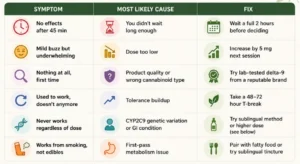
| Symptom | Most likely cause | Fix |
|---|---|---|
| No effects after 45 min | You didn’t wait long enough | Wait a full 2 hours before deciding |
| Mild buzz but underwhelming | Dose too low | Increase by 5 mg next session |
| Nothing at all, first time | Product quality or wrong cannabinoid type | Try lab-tested delta-9 from a reputable brand |
| Used to work, doesn’t anymore | Tolerance buildup | Take a 48–72 hour T-break |
| Never works regardless of dose | CYP2C9 genetic variation or GI condition | Try sublingual method or higher dose (see below) |
| Works from smoking, not edibles | First-pass metabolism issue | Pair with fatty food or try sublingual tincture |
How THC gummies are supposed to work
Understanding the process helps you figure out where it’s breaking down for you.
When you eat a THC gummy, your stomach breaks it down and releases the THC. The THC travels to your small intestine, where it gets absorbed into your bloodstream. From there, it goes to the liver.
In the liver, an enzyme called CYP2C9 (part of the larger cytochrome P450 enzyme family) converts delta-9 THC into a metabolite called 11-hydroxy-THC. This metabolite is significantly more potent than the THC you’d absorb through your lungs from smoking or vaping. It crosses the blood-brain barrier more efficiently and produces a stronger, longer-lasting high.
That whole journey takes time. Onset is typically 30 to 90 minutes, sometimes up to two hours on a full stomach. Once 11-hydroxy-THC reaches your brain and binds to CB1 receptors in your endocannabinoid system (ECS), you feel it. Effects last 4 to 8 hours.
If any step in this chain underperforms, the gummy “doesn’t work.” The question is which step.
Reason 1: you didn’t take enough
This is the most common explanation and the easiest to fix.
THC gummies come in a wide range of potencies. A 2.5 mg microdose gummy is going to produce very different effects than a 25 mg gummy. If you took 5 mg and felt nothing, that doesn’t mean gummies don’t work for you. It means 5 mg isn’t your threshold.
Your effective dose depends on your body weight, tolerance, metabolism, and individual ECS sensitivity. For a detailed breakdown, see our THC gummies dosage chart.
How to fix it: increase your dose by 5 mg per session until you find your minimum effective dose. If 5 mg didn’t work, try 10 mg next time. If 10 mg didn’t work, try 15 mg. Go slowly. The goal is to find the lowest dose that produces the effects you want, not to jump straight to 50 mg.
Reason 2: you didn’t wait long enough
The second most common cause. THC gummies are processed through your digestive system, not your lungs. They take 30 to 90 minutes to kick in, and sometimes up to two hours if you ate a heavy meal beforehand.
Many people eat a gummy, feel nothing at the 45-minute mark, eat another one, and then get hit by both doses at once 90 minutes later. That’s how overconsumption incidents happen.
How to fix it: wait a full two hours before deciding the gummy didn’t work. If after two hours you feel nothing at all, add 5 mg for your next session (not the same day if possible).
Reason 3: you’re eating delta-8 instead of delta-9
Check the label. Delta-8 THC is roughly half as potent as delta-9 THC, milligram for milligram. A 25 mg delta-8 gummy produces effects comparable to about 10 to 15 mg of delta-9.
Many gas-station and smoke-shop gummies are delta-8 (or even delta-10 or HHC), marketed with big milligram numbers that make them look potent. If you’re taking 10 mg of delta-8 gummies expecting a delta-9 experience, you’ll likely feel underwhelmed.
How to fix it: if you want a full THC experience, switch to delta-9 THC gummies from a brand that publishes third-party lab results. Or increase your delta-8 dose to account for the potency difference.
Reason 4: the product is low quality
Not all gummies contain what the label says. Unregulated products (gas station, convenience store, unlicensed online shops) frequently test below their labeled potency. A gummy marketed as 25 mg might contain 5 mg or less. Some contain no detectable THC at all.
The bigger quality issue is isolate vs. full-spectrum extraction. THC isolate contains only the THC molecule with no supporting cannabinoids or terpenes. Full-spectrum extracts contain the plant’s natural range of cannabinoids (THC, CBD, CBG, CBN, CBC) plus terpenes, which work together through the entourage effect to produce stronger, more well-rounded effects. Isolate-based gummies can feel flat or one-dimensional by comparison.
How to fix it: buy from brands that publish Certificates of Analysis (COAs) from accredited third-party labs. Verify that the lab results match the label claim. BudPop tests every batch and posts results on the lab testing page. If you want the strongest possible entourage effect, try live resin gummies or live rosin gummies, which preserve the full terpene profile.
Reason 5: your gummies lost their potency
THC degrades over time, especially when exposed to heat, light, and oxygen. A gummy that was 10 mg six months ago might be 5 mg or less now if it was stored in a warm cabinet or left in the sun.
How to fix it: check the expiration or manufacturing date. Gummies generally stay potent for 6 to 12 months when stored properly (cool, dark, airtight). If yours are past that window, replace them. Store new gummies in their original sealed packaging in a drawer or cabinet at room temperature.
Reason 6: your metabolism is working against you
Your metabolic rate affects how quickly your liver processes THC. People with fast metabolisms can break down THC so quickly that 11-hydroxy-THC doesn’t build up to a meaningful concentration in the bloodstream before it’s cleared.
This is often compounded by body composition. THC is fat-soluble. People with lower body fat percentages may process and eliminate it faster.
How to fix it: eat your gummy with or after a meal that contains fat. Avocado, nuts, cheese, peanut butter, or even a glass of whole milk can help. Dietary fat slows down digestion, extends the absorption window, and gives THC something to bind to. Some users find that taking their gummy 30 minutes after a fatty meal significantly changes the experience.
If you have a fast metabolism and an empty stomach, THC can pass through your system before enough 11-hydroxy-THC accumulates to produce noticeable effects.
Reason 7: the CYP2C9 genetic variation
This is the reason most THC gummy guides skip, and it’s the most important one for people who’ve tried everything else and still feel nothing.
Your liver uses the CYP2C9 enzyme to convert delta-9 THC into 11-hydroxy-THC. About 15 to 20% of the population carries a genetic variant (most commonly CYP2C9*3) that significantly alters how this enzyme functions. Research suggests that people with two copies of the *3 variant can have up to three times more unconverted THC circulating in their blood but 70% less of the metabolic byproducts, meaning their liver is routing THC through a different metabolic pathway that may short-circuit the psychoactive effects.
This doesn’t mean THC is impossible for you. It means your body processes edibles differently from the majority. The cannabis community calls this being “ediblocked.”
How to know if this applies to you: if you consistently feel nothing from edibles at doses that work for everyone around you (20+ mg), but smoking or vaping cannabis works normally, the CYP2C9 variation is the most likely explanation. You can confirm it with a genetic test from services like 23andMe or AncestryDNA (look for CYP2C9 enzyme data in your raw genetic file).
How to work around it: try sublingual delivery. THC tinctures held under the tongue for 60 seconds are absorbed through the mucous membranes directly into the bloodstream, partially bypassing the liver’s first-pass metabolism. You can also try significantly higher edible doses (30 to 50 mg+) since some CYP2C9 variant carriers respond at higher thresholds. Or switch to vape cartridges or flower, which bypass liver metabolism entirely.
Reason 8: digestive health conditions
Several GI conditions can reduce THC absorption from edibles:
Gallbladder removal (cholecystectomy): Your gallbladder stores bile, which helps emulsify fats. Without it, fat digestion is less efficient. Since THC is fat-soluble, reduced bile output means reduced THC absorption.
IBS, Crohn’s, or IBD: Inflammatory bowel conditions can reduce the absorptive surface area of your intestinal lining. If your gut can’t absorb nutrients efficiently, it won’t absorb THC efficiently either.
Gut microbiome imbalance: Emerging research suggests that the diversity and composition of your gut bacteria can influence cannabinoid metabolism. Antibiotic use, poor diet, and chronic inflammation all affect gut health.
Gastric bypass surgery: Surgical reduction of the stomach and intestinal rerouting can dramatically change absorption kinetics for all oral medications, including THC edibles.
How to fix it: if you have a diagnosed GI condition, sublingual tinctures or inhaled cannabis (vaping, smoking) will work better for you than edibles. These methods bypass the digestive system entirely.
Reason 9: tolerance buildup
If gummies used to work and don’t anymore, tolerance is the likely cause. Regular THC use downregulates your CB1 receptors, meaning you need more milligrams over time to achieve the same effect. This happens faster with daily use.
How to fix it: take a tolerance break. Even 48 to 72 hours off can partially reset your sensitivity. A full week off is more effective. If you can’t take a break, try increasing your dose by 5 mg increments and consider rotating between delta-9, delta-8, and THCP gummies to take advantage of different receptor-binding profiles.
Reason 10: medication interactions
If you take prescription medications metabolized by the CYP450 enzyme system, those medications may compete with THC for the same liver enzymes. This can either speed up or slow down THC metabolism, depending on the drug.
Common medication categories that interact with CYP2C9/CYP3A4 (the enzymes that process THC): blood thinners (warfarin), antiepileptics (phenytoin), certain antidepressants (SSRIs), proton pump inhibitors, and some antifungals.
How to fix it: if you take any of these medications and edibles don’t work for you, talk to your doctor. They can advise on timing and potential interactions. Do not adjust your medication doses without medical guidance.
Do edibles work on everyone?
Yes. Every human has an endocannabinoid system with CB1 and CB2 receptors. Every human body can process THC. The question is never “can my body feel THC?” but rather “what dose, delivery method, and product type works for my specific biology?”
For the vast majority of people, the fix is simple: higher dose, better product, more patience. For the 15 to 20% with CYP2C9 variations, sublingual or inhaled delivery methods bypass the bottleneck entirely. For people with GI conditions, the same alternative routes apply.
Nobody is truly immune to THC. Your system just needs the right entry point.
BudPop THC gummies worth trying
If product quality is the issue, upgrading your gummies solves it. BudPop tests every batch for potency and purity with third-party labs. Certificates of Analysis are published here.
- Delta-9 THC gummies for the standard, full-strength experience
- Delta-8 THC gummies for a milder, less anxiety-prone option
- THCP gummies for experienced users who need higher potency
- Live resin gummies for maximum entourage effect
- Live rosin gummies for solventless, premium full-spectrum
Not sure which to start with? The THC gummies collection page lets you compare all options.
These statements have not been evaluated by the FDA. These products are not intended to diagnose, treat, cure, or prevent any disease. Consult your physician before use. You must be 21 or older to purchase.
Frequently asked questions
What percentage of people can’t get high from edibles?
Roughly 15 to 20% of the population carries CYP2C9 enzyme variants that alter how their liver metabolizes THC from edibles. This doesn’t make them immune to THC. It means edibles may not work at standard doses, or their body may need a different delivery method (sublingual, inhaled) to bypass liver metabolism.
What does “ediblocked” mean?
It’s a slang term in the cannabis community for people who consistently feel no effects from edible THC, even at high doses that work for others. It’s almost always linked to CYP2C9 genetic variations or GI absorption issues, not a flaw in the product.
Should I take more gummies if I don’t feel anything?
Not on the same day. Wait a full two hours from your initial dose. If you feel absolutely nothing after two hours, don’t redose today. Instead, increase your dose by 5 mg the next time you take edibles. Stacking doses within the same session is how overconsumption happens.
Can I test whether I have the CYP2C9 variation?
Yes. Consumer genetic tests like 23andMe and AncestryDNA include CYP2C9 data in their raw genetic files. You can also request pharmacogenomic testing through your doctor, which maps how your liver enzymes process various substances, including THC.
Do edibles work differently than smoking?
Very differently. Smoked or vaped THC enters your bloodstream through the lungs and reaches your brain within minutes. Edible THC passes through your digestive system and liver first, where it’s converted into 11-hydroxy-THC, a more potent metabolite. The onset is slower (30 to 120 minutes vs. 5 to 15 minutes), the effects are typically stronger per milligram, and the duration is longer (4 to 8 hours vs. 1 to 3 hours). Your tolerance to inhaled THC does not translate directly to edible tolerance.
Will eating THC gummies on an empty stomach help?
It can speed up absorption, but the results are unpredictable. On an empty stomach, THC hits faster and potentially harder, but fades quicker. A more reliable approach is eating your gummy with a fatty food (avocado, nuts, cheese). Dietary fat improves THC bioavailability because THC is fat-soluble. The fat slows digestion and gives THC more time to be absorbed properly.
Why do edibles work for my friends but not me?
The most likely explanation is biology: differences in your CYP2C9 enzyme profile, your metabolic rate, your body fat percentage, your gut health, or your CB1 receptor density. Two people can eat the same gummy from the same batch and have entirely different experiences. If you’ve ruled out dosing, product quality, and patience, the CYP2C9 genetic variation or a GI absorption issue is the next thing to investigate.
Is there a way to make edibles work faster?
Sublingual absorption bypasses some of the digestive delay. If your gummy is soft enough, hold it under your tongue for 60 seconds before chewing and swallowing. You’ll absorb some THC through the sublingual membranes (faster onset) while the rest goes through the normal digestive route. This hybrid approach works for some people who find standard oral ingestion too slow or unreliable.