A cartridge works well or badly because of two parts: the heating element and the oil chamber. Most quality problems come from one of those two, not from the cannabinoid itself.
Decarboxylation in Action – How Vaporizer Heating Elements Convert Acidic Distillates
Decarboxylation is the process that turns acidic cannabinoids like THCa into active delta-9 THC, and your cartridge’s heating element does it every time you take a puff. The result depends on both temperature and time. Too little heat means only partial conversion and a weak effect. Too much heat burns off the terpenes and breaks the cannabinoids down into other compounds.
The efficiency ceiling is higher than most people think. A properly calibrated vaporizer heating element can reach decarboxylation efficiency of 97.3% or more, meaning almost all of the acid precursor becomes active cannabinoid with very little wasted. That only holds when the hardware runs within its voltage range, which is why battery voltage settings matter so much for THCa formulas.
Ceramic Cores vs Metal Coils – Preventing Thermal Degradation and Dry Hits
Ceramic cores spread heat more evenly across the wick, so there are fewer hot spots that scorch the oil and cause the burnt taste known as a “dry hit”. Metal coils such as nichrome or kanthal heat up faster, but over a smaller contact area. With thicker oils like delta-8 or THCp, that concentrated heat can scorch the oil instead of turning it into vapor.
When we tested both core types with our formulas, ceramic consistently kept the flavor better and clogged less. The one catch is that ceramic cores need a little time to prime after you load a new cartridge: take two or three gentle draws first without switching the battery on.
Distillates, Live Resin, and Full-Spectrum Extraction Standards
The oil inside a cartridge shapes the experience more than any hardware spec. Three extraction types dominate the market right now.
High THC Carts vs Live Resin Vapes – Flavor Retention and Terpene Preservation
Live resin keeps the plant’s profile from the moment it was frozen. Distillate loses most of its terpenes during processing, and terpenes are added back afterward, usually botanical ones rather than cannabis terpenes. You can taste the difference: live resin tastes like the strain it came from, while distillate carts taste either like generic cannabis or like artificial fruit flavoring.
If flavor is your priority, live resin is the way to go, because it keeps the aroma and taste that distillate loses from strain to strain. If potency matters more to you than taste, a pure distillate cartridge is the better choice.
Delta-8, Delta-9, and THCa Vape Formulations – Comparing Onset Mechanics and Potency
Inhaled cannabinoids are absorbed quickly through the lungs into the bloodstream, which makes vaping much faster than edibles: effects start in 2 to 10 minutes instead of 45 to 90. Since onset is about the same across vape formulas, what really sets them apart is potency and legal status.
Cannabinoid
Onset
Relative intensity
Source
Farm Bill status
Delta-8 THC
2-10 min
Moderate
Hemp-derived
Compliant (under 0.3% delta-9)
Delta-9 THC
2-10 min
Moderate-high
Hemp-derived
Compliant at legal mg thresholds
THCa
2-10 min (after decarb)
High (converts to delta-9)
Hemp-derived
Compliant in raw form
THCp
2-10 min
Very high
Hemp-derived
Compliant
HHC
2-10 min
Moderate
Hemp-derived
Compliant
THCp stands apart. It binds to CB1 receptors more strongly than delta-9 THC, which is why many people feel THCp formulas much more, even at low amounts. If you’re new to it, take one short puff and wait about ten minutes before the next one.
Viscosity Management – Why Pure Concentrates Eliminate Chemical Cutting Agents
Thinner oil clogs less but delivers fewer cannabinoids per draw. Thicker oil delivers more per draw but flows poorly at some temperatures and can clog small intake holes, which is why the industry has used cutting agents in the past.
Cutting agents have a bad track record. Vitamin E acetate, used to thicken illicit THC cartridges, was linked to the 2019 EVALI outbreak that sent thousands of people to the hospital. The answer to viscosity isn’t additives. It’s natural cannabis oil, full-spectrum or distillate, formulated to the right thickness on its own.
Battery Compatibility, Airflow Design, and Physical Performance
Even great oil will underperform in a badly designed cartridge. Hardware specs aren’t marketing details. They decide how every single draw feels.
510 Thread Universal Standards vs Proprietary Pod Systems – Hardware Versatility
A 510-thread cartridge works with any 510-thread battery, which is why 510 is the universal standard. Proprietary pod systems lock you into one company’s battery, which is a problem if it breaks or you want to switch devices.
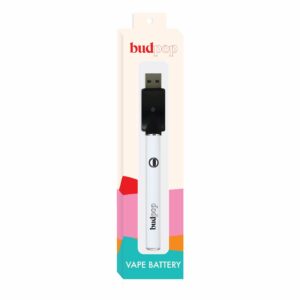
Every BudPop cartridge is 510-thread compatible, so you’re never stuck with a proprietary system. If you already have a variable-voltage 510 battery, it will work. If you don’t, standard 510 batteries are easy to find in smoke shops and online.
Draw resistance depends on the size and number of airways in the cartridge body. A draw that’s too tight is uncomfortable and can cause condensation in the mouthpiece. One that’s too loose won’t give you dense enough vapor.
The biggest mistake new cartridge users make is pulling too hard. Take gentle 3 to 4 second draws instead, which pulls vapor much more efficiently. A fast, hard pull can flood the coil with oil and make the cartridge gurgle or spit. If it starts gurgling, blow gently into the mouthpiece (with the battery off) to clear the pooled oil.
Leaks happen in two places: where the tank meets the atomizer base, and through the intake holes that feed oil to the coil. If those holes are too wide for the oil’s viscosity, gravity pulls oil through too fast, flooding the chamber and leaking out at the connection.
Good cartridges match the intake hole size to the viscosity of the oil inside. A silicone seal at the base keeps oil out of the battery’s 510 connector, where it would corrode the contacts over time. To take stress off the seals, store your cartridges upright at room temperature.
Legal Compliance, Online Shipping, and Bulk Logistics
Farm Bill Compliance Frameworks – Navigating Inter-State Shipping Regulations in 2026
Hemp-derived THC products in the US fall under the 2018 Farm Bill, which made hemp and hemp-derived cannabinoids federally legal as long as they contain no more than 0.3% delta-9 THC on a dry weight basis. BudPop products are made to meet those rules.
State law is a separate layer. Some states restrict specific cannabinoids, including delta-8, whatever their status under federal hemp law. Before you order, check where your state currently stands on the cannabinoid you’re buying. We don’t ship to states where a product isn’t allowed, and our checkout includes regional restrictions.
Ordering THC Carts Online vs Local Retail Sourcing – Storage Freshness and Batch Verification
One real advantage of buying THC cartridges straight from the brand is batch traceability. In a physical shop it can be hard to know when a batch was made, how old it is, or how to find its Certificate of Analysis (COA) if the lot number isn’t on the package. When you buy direct, you get the COA for that exact batch.
Direct-to-consumer shipping also keeps products fresher than retail supply chains, where cartridges can sit in warehouses for weeks or months at changing temperatures. Cool, stable conditions are what preserve terpenes, so a cartridge that’s spent months somewhere warm won’t taste like a fresh batch.
For B2B buyers, the non-negotiable minimum for any THC cartridge shipment is tamper-evident packaging on every unit and case, plus protection from light and temperature in transit. Shrink-wrap seals on cartridge tips show the mouthpiece hasn’t been exposed since production. A batch number on every unit also means a recall can target a single SKU instead of pulling the whole line.
When you evaluate wholesale suppliers, ask for COAs for the exact batches you’re receiving, not generic COAs from an earlier production run. Potency and contamination results are batch-specific, and a six-month-old COA tells you nothing about the product you’re about to get.
Cost-per-Milligram Economics – Evaluating Value Across High Potency Cartridge Sizes
To judge a cartridge’s real value, look at the cost per milligram of active ingredient, not the sticker price. A $30 cartridge with 500 mg works out to $0.06 per mg. A $45 cartridge with 1,000 mg costs $0.045 per mg, so despite the higher price, it’s 25% cheaper per milligram.
BudPop vapes contain 400 to 1,800 mg of hemp-derived cannabinoids depending on the product, which keeps them among the better values per milligram. Free shipping on orders over $99 brings the cost down further when you buy several, another reason buying THC cartridges online beats paying a local markup.
Safety Verification, Testing Standards, and Hardware Care
Reading Analytical Lab Certificates – Auditing Residual Solvents, Heavy Metals, and Microbials
A Certificate of Analysis is only useful if you know how to read it. A COA you rely on for safety should cover five sections: cannabinoid potency, residual solvents, heavy metals, pesticides and microbials. A potency result on its own says nothing about safety.
States have built their own contaminant testing rules. The categories are the same, but acceptable limits differ from one state to the next. When you read a COA, check that the lab is accredited (ISO 17025 is the standard that matters), that results are measured against defined action limits, and that the batch number on the COA matches your product. BudPop provides batch-specific COAs for every product.
Preventative Maintenance Guidelines – Temperature Calibration and Voltage Optimization
Voltage is where all of this comes together. Most hemp oils, distillate and live resin alike, perform best between 2.4V and 3.2V. Below 2.4V, the oil may not vaporize properly.
Keep cartridges out of direct sunlight at 60 to 75°F. Cold makes the oil thicker and can leave the coil dry on the first draw, so if a cartridge has been somewhere cold, warm it in your hand for a minute before using it. Wipe the 510 connection now and then so residue doesn’t build up and interfere with the connection.
Manufacturing Quality Benchmarks – Defining Standards for Premium THC Cartridges
Premium THC cartridges meet a clear set of standards that average products tend to skip. Supply chain control starts with US-grown hemp, which has to follow USDA rules, unlike hemp grown elsewhere. Next come non-GMO oil, third-party testing and batch COAs you can actually access. On the hardware side: a ceramic core, 510 threading, intake holes sized to the oil’s viscosity and a silicone seal at the base.
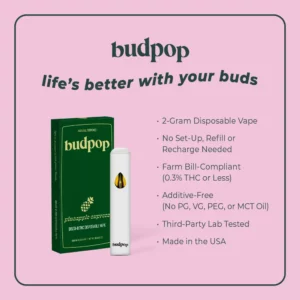
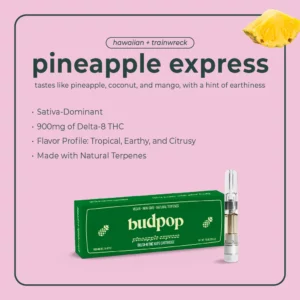
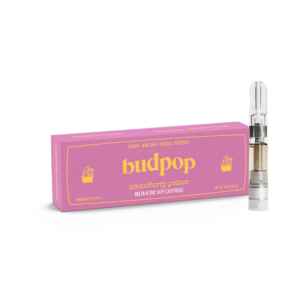
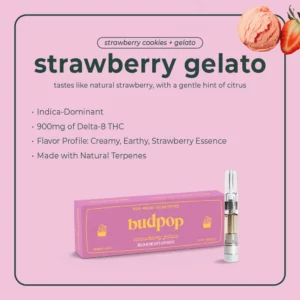
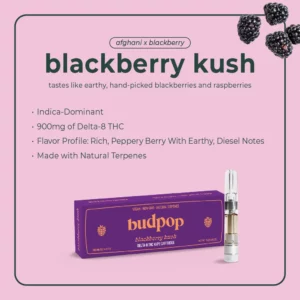
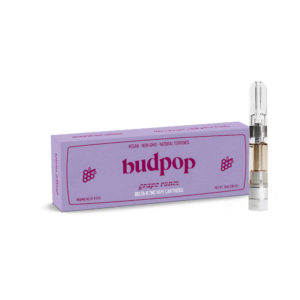
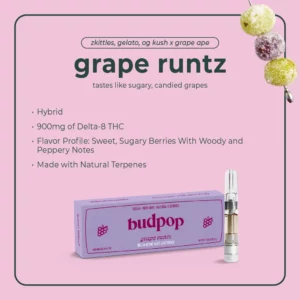
BudPop vapes are made from US-grown, non-GMO hemp and third-party lab tested with COAs. The lineup covers delta-8, THCa and THCp, in strains like Grape Runtz, Blackberry Kush, Pineapple Express and Strawberry Gelato. Sales are limited to customers 21 and older.
FAQ - THC Cartridges & Vape Pens
What hardware specs ensure a 510-thread THC cartridge won't clog or leak?
To avoid clogs, the intake hole size has to match the oil’s viscosity, and a ceramic core spreads heat evenly so oil doesn’t gum up the wick. To avoid leaks, you need silicone seals at the atomizer base and a tight tank-to-coil connection with no gaps. Always store cartridges upright and use them between 2.4 and 3.2V. With a new cartridge, prime it first with two or three dry pulls.
How do THCa vape cartridges convert to psychoactive Delta-9 THC upon activation?
THCa is the acid form of delta-9 THC and isn’t psychoactive until it’s heated. When the cartridge’s heating element fires, it triggers decarboxylation, which removes a carboxyl group from THCa and turns it into delta-9 THC. It happens in milliseconds.
Are hemp-derived THC carts legal to order online and ship in 2026?
Hemp-derived THC cartridges that meet the 2018 Farm Bill delta-9 THC limit are allowed at the federal level and can be shipped across state lines. State laws matter too: some states ban specific cannabinoids such as delta-8 regardless of federal status. Always check your state’s current laws before you buy. BudPop only ships to states where a given product is allowed, and buyers must show valid ID proving they’re 21 or older.
What is the optimal voltage range for preserving natural strain terpenes while vaping?
Most distillate and live resin cartridges work best between 2.4 and 3.2 volts. Lower than that, thick oils may not vaporize fully. Going above 3.5 volts breaks down terpenes fast and creates byproducts you don’t want to inhale. On a variable-voltage battery, start at the lowest setting and only turn it up if the vapor is too thin.
How can consumers verify that a vape cartridge is free from Vitamin E acetate and heavy metals?
Ask for the COA for your specific batch before you buy. A complete safety COA should include residual solvent testing (which will flag vitamin E acetate if it’s there), heavy metals testing for at least lead, mercury, arsenic and cadmium, plus microbial and pesticide tests. Check that the lab holds ISO 17025 accreditation and that the batch number on the COA matches the product label. If the brand can’t give you a batch-specific COA, buy elsewhere.