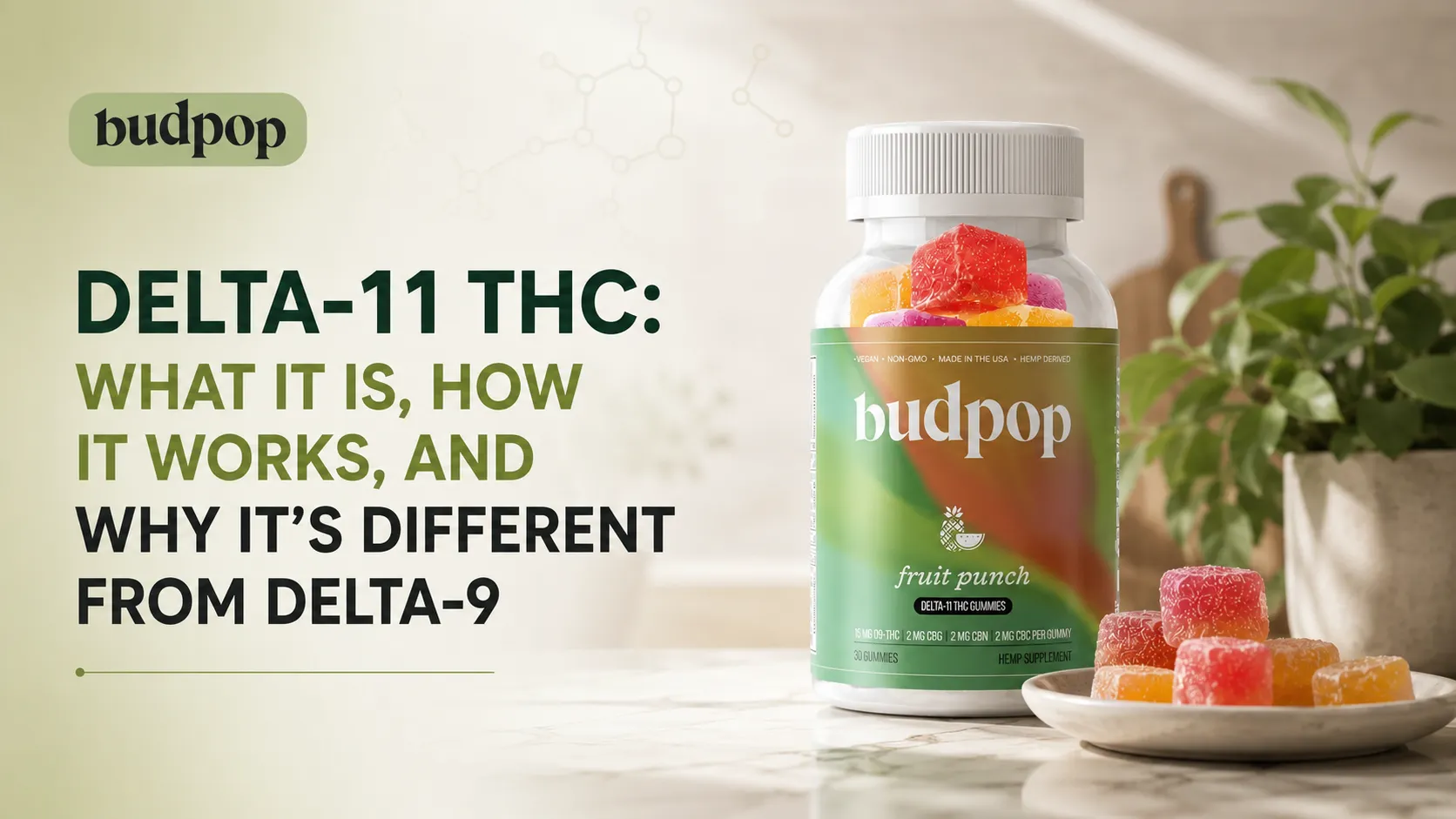
Delta-11 THC is one of the most confusing cannabinoids in the hemp market because the name is used to describe two different things depending on who’s talking. Some brands use “Delta-11” to refer to 11-hydroxy-THC (the potent metabolite your liver creates from any THC you eat). Others use it to describe a distinct isomer of THC with a double bond at the 11th carbon position. These are different molecules with different properties, and the market conflates them constantly.
Below is what each version actually is, why the distinction matters for the gummies you buy, and how Delta-11 fits into the broader cannabinoid potency hierarchy alongside Delta-9, Delta-8, THCP, and THCH.
The two “Delta-11” compounds (and why the market is confused)
Version 1: 11-Hydroxy-THC (the liver metabolite)
When you eat a THC gummy, your liver converts Delta-9 THC into 11-hydroxy-THC (written as 11-OH-THC) through first-pass metabolism via CYP2C9 enzymes. This metabolite is 2 to 3 times more potent than the Delta-9 you swallowed and crosses the blood-brain barrier more efficiently.
11-hydroxy-THC is the reason edibles feel stronger than smoking at the same milligram count. When you inhale THC, it goes directly from lungs to brain, bypassing the liver. When you eat it, the liver creates 11-OH-THC as an intermediate step, and that metabolite produces the deeper, more intense body experience that edible users describe.
Some hemp brands market products as “Delta-11” when they’re actually referring to formulas designed to maximize 11-hydroxy-THC production in the liver. This isn’t a separate cannabinoid you can extract from hemp. It’s a metabolite your body creates from any ingested THC.
Why it matters for BudPop customers: Every BudPop edible (gummies, etc.) produces 11-hydroxy-THC as part of normal digestion. You don’t need a special “Delta-11” product to get this metabolite. BudPop’s Cosmic Punch (15mg D9) produces 11-OH-THC naturally when your liver processes the Delta-9 content. The multi-cannabinoid formula (D9 + CBC + CBG + CBN) means the 11-OH-THC production happens alongside activation of 4 additional receptor pathways.
Version 2: Delta-11 THC isomer (the rare cannabinoid)
A true Delta-11 THC isomer would have its double bond at the 11th position of the THC molecule (versus the 9th position for Delta-9 or the 8th for Delta-8). This compound has been identified in research literature but occurs in cannabis at concentrations so low that commercial extraction is impractical.
Like THCH and THCP, any Delta-11 isomer sold commercially would be synthesized from hemp-derived CBD through isomerization. The pharmacological profile of true Delta-11 THC isomer hasn’t been characterized in published human studies. Claims about its effects are extrapolated from its molecular structure, not from clinical data.
The honest assessment: Most “Delta-11” products on the market are either relabeled Delta-9 formulas (marketing the 11-OH-THC metabolite as a feature), or they contain a synthesized isomer with unverified effects. Neither scenario offers something that a well-formulated Delta-9 gummy or multi-cannabinoid product doesn’t already provide.
Where Delta-11 fits in the potency hierarchy
| Cannabinoid | CB1 Binding | Subjective Potency vs D9 | Duration | Source |
|---|---|---|---|---|
| Delta-8 THC | ~60-70% of D9 | 0.6x | 4 to 6 hours | Synthesized from CBD |
| Delta-9 THC | Baseline (1x) | 1x | 4 to 8 hours | Extracted or synthesized |
| 11-OH-THC (liver metabolite) | ~2-3x D9 | 2 to 3x | Part of edible duration | Created by your liver |
| Delta-11 isomer | Unknown (no published data) | Unknown | Unknown | Synthesized from CBD |
| THCH | ~1.1x D9 | 5 to 10x (user-reported) | 4 to 6 hours | Synthesized from CBD |
| THCP | ~33x D9 | 10 to 33x | 12 to 24+ hours | Synthesized from CBD |
The key takeaway: 11-OH-THC (the metabolite version) is real, well-studied, and produced naturally when you eat any THC gummy. The Delta-11 isomer is poorly characterized and offers no proven advantage. Products specifically marketed as “Delta-11” should be evaluated with extra skepticism.
Why multi-cannabinoid gummies outperform single-compound products
Instead of chasing obscure cannabinoids like Delta-11, the more effective approach is combining well-characterized cannabinoids at complementary doses. This is BudPop’s core formulation philosophy.
BudPop’s All Star Relief gummies combine THCH + D9 + THCP in a single product. That’s three different carbon chain lengths (5, 6, 7) activating CB1 receptors at three different binding intensities and durations. The entourage effect from this combination produces deeper, more layered effects than any single compound (including hypothetical Delta-11) can achieve alone.
The practical comparison:
A “Delta-11” gummy from an unknown brand: Unclear what’s actually in it. No published research on the active compound. Effects could be identical to standard D9 (if the “Delta-11” claim refers to the liver metabolite). No multi-cannabinoid depth.
BudPop’s Cosmic Punch (15mg D9 + CBC + CBG + CBN): Four verified cannabinoids, each targeting different receptor pathways. COA-verified potency with 2.1% variance. 202 reviews at 4.90 stars. Scored 96.7/100 in independent audit. Your liver creates 11-OH-THC from the D9 content automatically, so you’re getting the “Delta-11 metabolite” plus three additional cannabinoids.
The formula with verified, stacked compounds wins over the formula with one unverified compound every time. For the science behind why combinations work, read the entourage effect explained.
Is Delta-11 THC legal?
Delta-11’s legal status follows the same framework as other hemp-derived cannabinoids.
Federal: If synthesized from hemp-derived CBD and the finished product contains less than 0.3% Delta-9 THC by dry weight, Delta-11 products are technically legal under the current 2018 Farm Bill interpretation.
November 2026 change: The federal regulations taking effect November 12, 2026 explicitly ban synthetic and semi-synthetic cannabinoids from the “hemp” definition. If Delta-11 is produced through synthesis (which all commercial Delta-11 is), it would become federally illegal after the grace period. Read the full Hemp Farm Bill 2026 analysis.
State level: Several states have already restricted synthesized cannabinoids, which would include commercial Delta-11. Check your state’s current hemp laws.
What to buy instead (BudPop’s verified alternatives)
If you’re searching “Delta-11” because you want something stronger than standard Delta-9, BudPop has options with actual research backing and verified potency:
For stronger effects (daytime): All Star Relief (THCH + D9 + THCP). THCH alone produces 5 to 10x D9 perceived potency. Combined with THCP’s 33x binding affinity, this is the strongest legal gummy formula available. Full comparison: THCH vs THCP.
For stronger effects (evening): Twilight Indica Live Rosin (18mg D9 with 8%+ terpene retention). The myrcene-heavy indica terpene profile increases blood-brain barrier permeability, making 18mg of D9 feel stronger than 18mg from a distillate gummy. Full guide: indica gummies.
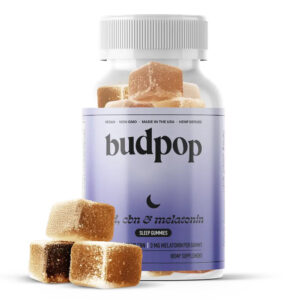
For stronger sleep effects: Lights Out Sleep (D9 + CBN + melatonin). CBN adds sedation that D9 alone doesn’t produce, without requiring higher D9 doses. Full guide: THC gummies for sleep.
For maximum potency at lower mg: THCP gummies deliver 10 to 33x D9 potency per milligram. If tolerance has made standard D9 ineffective, THCP resets the ceiling. Duration: 12 to 24+ hours. Start at 0.5mg.
For beginners who want “more” but safely: Chill Daytime (3mg THC + 25mg CBD). The CBD buffer lets you explore higher effective potency through the entourage effect without the anxiety risk of jumping to higher mg counts. Full guide: THC gummies for beginners.
THC RECOVERY PICKS
Feeling Too High From Edibles?
These hemp-derived products are popular for promoting calmer,
smoother, and more manageable THC effects.
Frequently asked questions
Is Delta-11 THC real?
11-hydroxy-THC (the liver metabolite) is real and well-studied. Your body creates it every time you eat a THC gummy. A distinct Delta-11 isomer (double bond at position 11) has been identified in research but is poorly characterized with no published human studies on its effects.
Is Delta-11 stronger than Delta-9?
11-OH-THC (the metabolite) is approximately 2 to 3x stronger than D9 and is part of what makes edibles feel more intense than smoking. But you get 11-OH-THC from any ingested D9 gummy automatically. Products branded “Delta-11” don’t provide anything a well-formulated D9 gummy doesn’t already produce through normal metabolism.
Should I buy Delta-11 gummies?
There’s no compelling reason to choose a “Delta-11” product over a verified multi-cannabinoid D9 product. BudPop’s Cosmic Punch (D9 + CBC + CBG + CBN) or All Star Relief (THCH + D9 + THCP) provide verified, stacked cannabinoids with published COAs. “Delta-11” products typically lack this level of verification.
How does Delta-11 compare to Delta-8?
If Delta-11 refers to the 11-OH-THC metabolite, it’s substantially stronger than Delta-8 (2-3x D9 potency vs D8’s 0.6x). If it refers to the uncharacterized isomer, the comparison can’t be made because no published data exists. For a well-studied mild option, BudPop’s Delta-8 gummies have 1,000+ verified reviews and predictable effects.
Will Delta-11 show up on a drug test?
Yes. All THC variants (D8, D9, D11, THCH, THCP) metabolize into THC-COOH, the marker detected by standard drug tests. Detection window: 3 to 30+ days depending on usage frequency.
Disclaimer: Delta-11 THC products have not been evaluated in human clinical trials. 11-hydroxy-THC is a naturally occurring metabolite, not a standalone product. Do not drive after consuming any THC product. Federal regulations changing November 12, 2026. You must be 21 or older.