
Gummies for nausea: how THC, CBD, and CBG reduce nausea (and when they don’t)
THC is one of the few natural compounds with genuine clinical evidence for nausea. Two FDA-approved THC-based medications (Dronabinol/Marinol and Nabilone/Cesamet) are specifically prescribed for chemotherapy-induced nausea when standard antiemetics fail. A 2024 phase II/III trial published in the Journal of Clinical Oncology found that a THC: CBD combination achieved complete nausea relief in 24% of chemo patients versus 8% on placebo, a 3x improvement.
But chemotherapy nausea is an extreme case. Most people searching for “gummies for nausea” are dealing with something milder: motion sickness, morning sickness during pregnancy, medication side effects, anxiety-induced nausea, or general GI upset. For these, the cannabinoid approach is different.
Here’s what each compound does for nausea, which dose ranges the research supports, and where cannabinoid gummies genuinely help versus where they don’t.
How THC stops nausea (the CB1 pathway)
Your brain has a vomiting center in the medulla oblongata and a chemoreceptor trigger zone (CTZ) in the area postrema. These two regions decide whether you feel nauseous and whether you actually vomit. CB1 receptors are dense in both areas.
When THC binds to CB1 receptors in the brainstem, it suppresses the signaling cascade that triggers the nausea-and-vomit response. A 2025 meta-analysis across 26 studies confirmed that cannabinoids had superior overall nausea control compared to placebo (risk ratio 2.65, 95% confidence interval 1.70 to 4.12). That’s a statistically significant antiemetic effect.
The FDA approved Dronabinol in 1985 and Nabilone in 2006 specifically because the CB1 antiemetic pathway is real, reproducible, and clinically meaningful. These are synthetic THC formulations prescribed when ondansetron (Zofran) and other first-line antiemetics aren’t enough.
Hemp-derived THC gummies work through the same CB1 pathway. The difference is dosing precision and regulation. Prescription Dronabinol starts at 5mg THC per capsule with medical supervision. Over-the-counter THC gummies start at similar or lower doses but without the clinical monitoring.
How CBD reduces nausea (the serotonin pathway)
CBD’s antiemetic mechanism is different from THC’s. CBD activates 5-HT1A serotonin receptors, which are involved in nausea regulation through a separate pathway from CB1. Ondansetron (Zofran), one of the most commonly prescribed antiemetics, also works on the serotonin system (specifically 5-HT3 receptors). CBD targets a different serotonin receptor subtype, so the mechanisms are complementary rather than redundant.
Preclinical studies consistently show CBD reducing nausea in animal models. Human clinical data is more limited. A Medical News Today review noted that most CBD nausea research centers on cancer patients, and the evidence is categorized as “emerging” rather than “established.”
CBD has one significant advantage over THC for nausea: it’s non-psychoactive. If you’re nauseous at work, during travel, or in any situation where you need full cognitive function, CBD provides potential antiemetic support without impairing you.
An interesting aside: CBDA (cannabidiolic acid, the raw precursor to CBD) shows even stronger antiemetic activity than CBD itself in animal models. CBDA is found in raw, unheated hemp products. Most gummies contain decarboxylated CBD (heated during production), not CBDA, but some full-spectrum products retain trace CBDA.
How CBG contributes (the gut pathway)

CBG (cannabigerol) acts on receptors in the gut and nervous system. The 2025 Marijuana Doctors review highlighted CBG’s ability to reduce GI inflammation without psychoactive effects. For nausea caused by GI irritation (IBS, food sensitivity, medication-induced stomach upset), CBG may address the source of the nausea rather than just suppressing the brain’s nausea response.
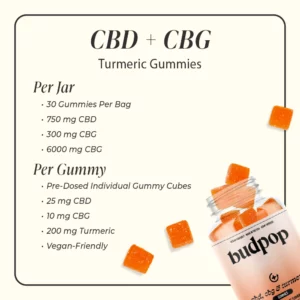
BudPop’s CBD + CBG Turmeric Gummies (25mg CBD + 10mg CBG + 100mg turmeric) combine the serotonin pathway (CBD), the gut pathway (CBG), and anti-inflammatory support (turmeric). For GI-related nausea specifically, this triple formula is the most relevant product in the BudPop catalogue.
Dosing gummies for different types of nausea
Chemotherapy-related nausea
This is the most studied use case. The 2024 JCO trial used 2.5mg THC + 2.5mg CBD as the starting dose, titrated upward. Some patients needed higher doses, and a small number couldn’t tolerate even 2.5mg THC.
If you’re undergoing chemotherapy, talk to your oncologist about cannabinoid antiemetics. Prescription Dronabinol or Nabilone may be more appropriate than OTC gummies because of dosing precision and medical monitoring. OTC THC gummies can supplement but shouldn’t replace your prescribed antiemetic regimen without medical guidance.
Motion sickness and travel nausea
Take a low-dose gummy (2.5 to 5mg THC or 25mg CBD) 60 to 90 minutes before the car ride, flight, or boat trip. The gummy needs time to reach your bloodstream through digestion, so taking it as nausea starts is usually too late for an edible format.
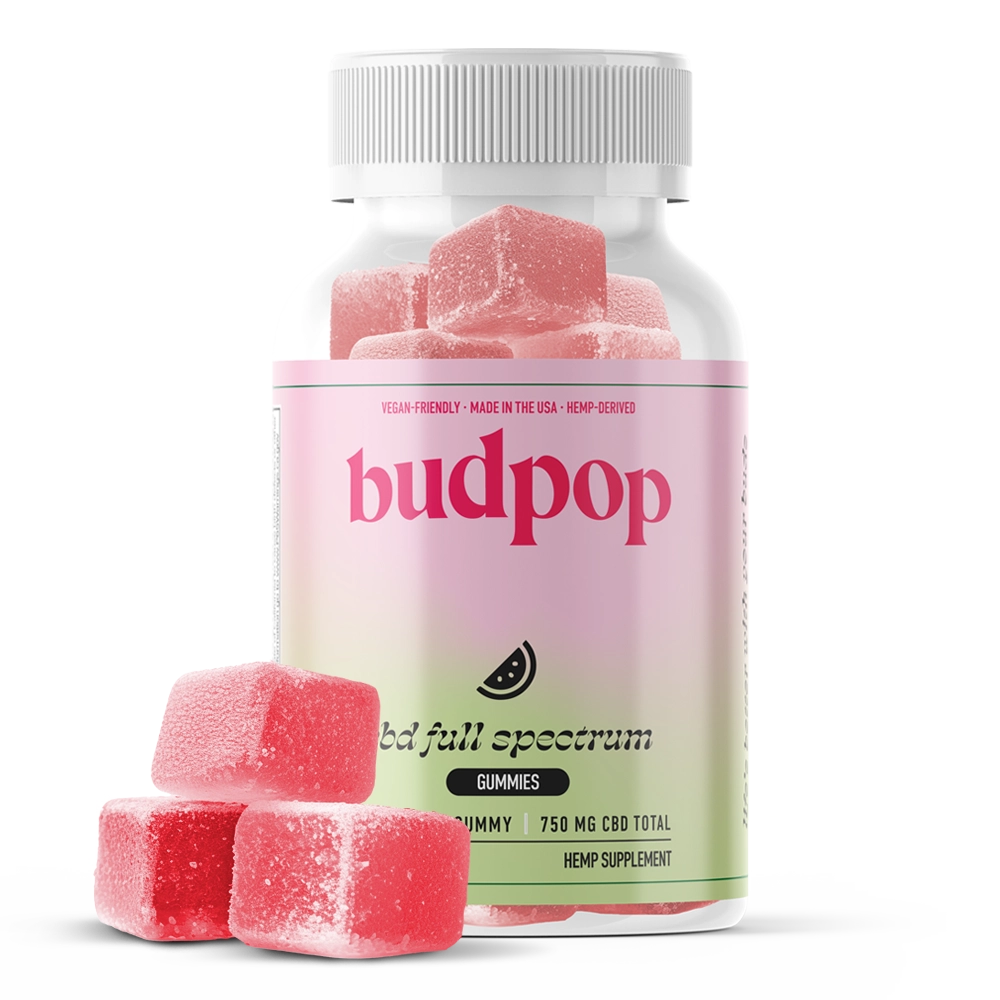
For motion sickness specifically, CBD may be preferable to THC because it doesn’t impair coordination or cognition during travel. BudPop’s Full Spectrum CBD Gummies (25mg CBD, Watermelon) provide the serotonin-pathway antiemetic support without psychoactive effects.
Anxiety-induced nausea (nervous stomach)
If your nausea is anxiety-driven (the “butterflies” before a presentation, the queasy feeling before a difficult conversation), the CBD 5-HT1A pathway is your primary target. The nausea isn’t coming from your stomach; it’s coming from your autonomic nervous system’s stress response sending signals to your gut.
BudPop’s CBD + Ashwagandha Gummies (25mg CBD + 150mg ashwagandha) address both the serotonin system (CBD) and the cortisol/HPA axis (ashwagandha). Reducing the anxiety reduces the nausea.
Morning sickness during pregnancy
This requires extreme caution. The American College of Obstetricians and Gynecologists (ACOG) explicitly recommends against cannabis use during pregnancy. THC crosses the placenta and may affect fetal development. CBD safety data during pregnancy is insufficient.
Do not use THC or CBD gummies for morning sickness without explicit approval from your OB-GYN. Standard options (ginger, vitamin B6, doxylamine/Unisom, ondansetron) have better safety profiles for pregnant patients.
Medication-induced nausea
Some prescription medications (antibiotics, NSAIDs, metformin, SSRIs) cause nausea as a side effect. CBD at 25mg may help through the serotonin pathway without interacting with most medications.
Caution: CBD inhibits CYP3A4 and CYP2D6 liver enzymes, which metabolize many common drugs. This can increase blood levels of the medication causing your nausea, potentially making the problem worse. Always check with your pharmacist about CBD-drug interactions before adding CBD to your medication routine.
When gummies DON’T work for nausea
Acute vomiting episodes. By the time you’re actively vomiting, a gummy takes too long to absorb. You might vomit the gummy itself before it reaches your bloodstream. For acute vomiting, sublingual THC/CBD tinctures (5 to 15 minute onset) or inhaled products (2 to 5 minute onset) are faster. Gummies are prevention, not rescue.
Food poisoning. Your body is vomiting to expel a pathogen. Suppressing the vomiting reflex with THC can delay your body’s clearance of the toxin. Let the food poisoning run its course. Stay hydrated. See a doctor if vomiting lasts more than 24 hours.
Cannabinoid hyperemesis syndrome (CHS). Heavy daily cannabis users can develop CHS, a condition where cannabinoids paradoxically cause severe cyclic nausea and vomiting. If you’re a heavy user and you’re experiencing worsening nausea, more cannabis is the wrong move. Stop all cannabinoid use and see a physician. Hot showers temporarily relieve CHS symptoms (the capsaicin-TRPV1 mechanism), but cessation is the only cure.
Vertigo-related nausea. If your nausea comes with room-spinning dizziness, it’s likely vestibular (inner ear). Cannabinoids don’t address vestibular dysfunction. See an ENT specialist.
THC RECOVERY PICKS
Feeling Too High From Edibles?
These hemp-derived products are popular for promoting calmer,
smoother, and more manageable THC effects.

Frequently asked questions
Do THC gummies help with nausea?
Yes. THC’s CB1 receptor binding in the brainstem vomiting center has genuine antiemetic activity. Two FDA-approved synthetic THC medications (Dronabinol and Nabilone) are prescribed specifically for nausea. Hemp-derived THC gummies work through the same pathway at comparable doses (2.5 to 5mg THC).
Can CBD gummies stop nausea?
CBD may reduce nausea through 5-HT1A serotonin receptor activation. The evidence is stronger in preclinical models than in human trials. For mild nausea (anxiety-related, travel, medication side effects), 25mg CBD is a reasonable starting dose. For severe nausea (chemotherapy), CBD alone is probably not sufficient. THC + CBD combinations show the strongest clinical results.
How many mg of THC for nausea?
Clinical trials start at 2.5mg THC (often combined with 2.5mg CBD). Most users find 2.5 to 5mg THC effective for mild to moderate nausea. Higher doses increase side effects (drowsiness, dizziness, psychoactive effects) without proportionally improving antiemetic activity. Low and slow is the correct approach.
Is Delta-8 good for nausea?
Preliminary evidence suggests Delta-8 has antiemetic properties similar to Delta-9 but at lower psychoactive intensity. Some users prefer D8 for nausea because the side effect profile is gentler. Clinical data specifically on D8 and nausea is very limited compared to Delta-9.
Disclaimer: This article is for informational purposes only and does not constitute medical advice. THC and CBD gummies are not FDA-approved treatments for nausea (though synthetic THC medications Dronabinol and Nabilone are FDA-approved antiemetics). Do not use cannabis products during pregnancy without explicit medical approval. Do not replace prescribed antiemetics with OTC gummies without consulting your healthcare provider. You must be 21 or older to purchase THC products.