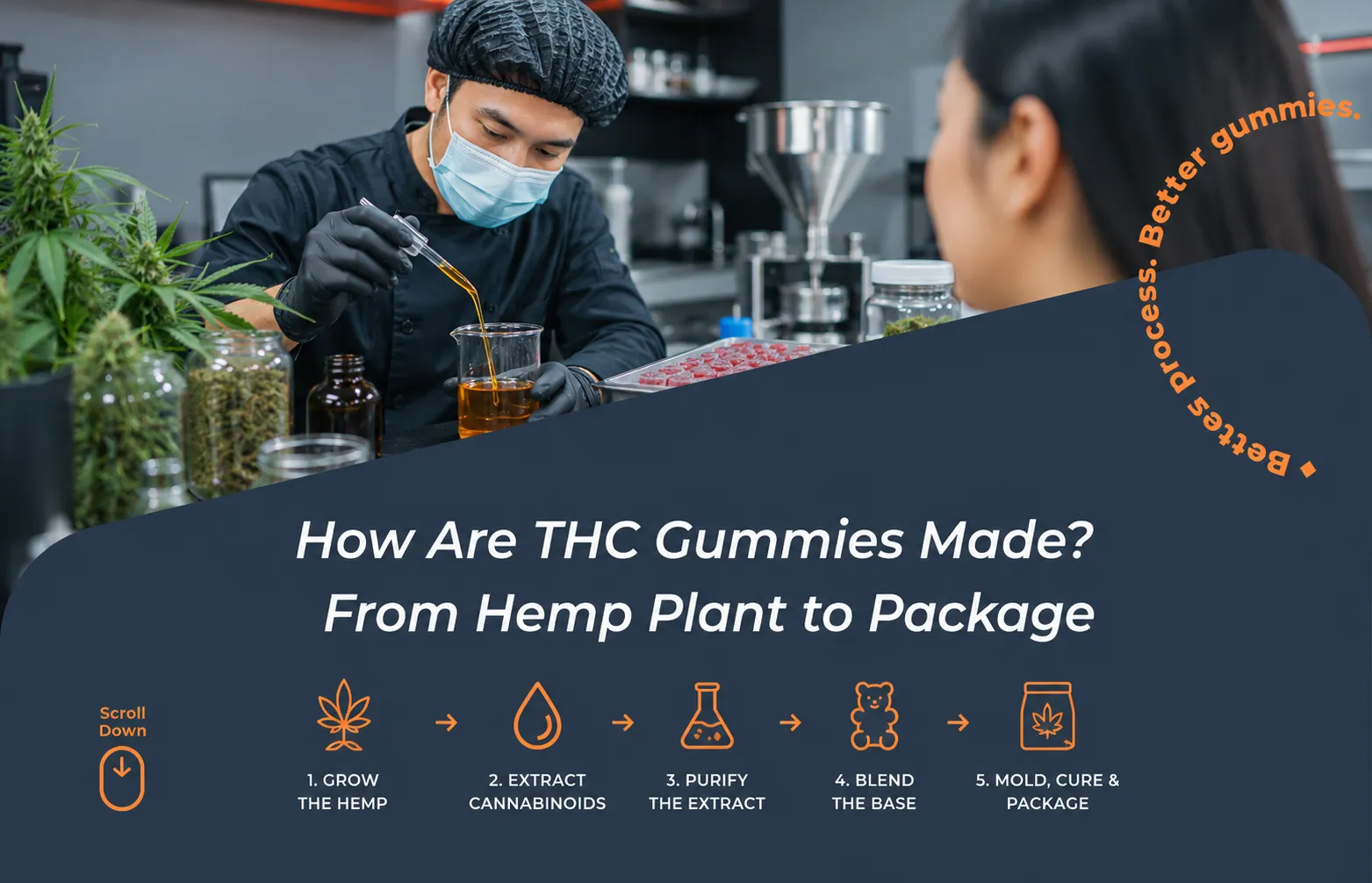
Learn how THC gummies are made in five steps. Hemp is grown and harvested. The cannabinoids are extracted from the plant. The extract is purified into a specific cannabinoid profile. The cannabinoids are blended with pectin or gelatin and natural flavours. The mix is poured into molds, cooled, and packaged. The whole process takes about 72 hours.
The five-step process, How are THC gummies made? in plain English
Most people buying THC gummies have no idea what’s inside them beyond the mg on the label. That’s a reasonable level of incuriosity for most consumer products. For something that affects how your brain works for 6 hours, a bit more transparency is worth having.
The process runs like this: grow the hemp, pull the cannabinoids out of the plant, clean up the extract, mix it into a gummy base, then mold and package the finished product. Each step has a clean version and a cut-corner version. The gap between them is why two 10 mg gummies from different brands can feel completely different.
Step 1: growing the hemp
Legal hemp in the US is grown under USDA oversight and must test below 0.3 percent THC by dry weight at harvest. The crop is planted, managed through the growing season, and harvested typically in late summer or early fall depending on the region.
Soil quality, pesticide use, and growing practices all matter because hemp is a bioaccumulator. It pulls compounds from the soil readily. Heavy metals, pesticides, and other contaminants in the soil end up in the plant, and from there, in the extract. This is why hemp source matters and why COA testing for heavy metals and pesticides is the only way to verify the starting material was clean.
US-grown hemp under USDA certification has documented soil and pesticide standards. Imported hemp doesn’t face the same oversight. The difference shows up in testing results, and reputable brands will tell you where their hemp comes from without being asked.
Step 2: Extracting the cannabinoids
After harvest, the plant material goes through extraction to pull out the cannabinoids. Two methods dominate the industry.
CO2 extraction uses pressurized carbon dioxide as a solvent. It’s precise, produces a clean extract, and leaves no chemical residue. It’s also the most expensive method and requires specialized equipment.
Ethanol extraction soaks the plant material in food-grade ethanol to dissolve the cannabinoids, then removes the ethanol through evaporation. Done well, it produces a clean extract. Done poorly, residual ethanol stays in the product.
Cheaper brands sometimes use hydrocarbon solvents like butane or propane. These are faster and cheaper. They also leave residual compounds in the extract if the purification step is skipped or rushed. A COA with a residual solvent panel will catch this. A COA testing only for potency won’t.
Step 3: the naturally derived vs synthesized fork
After extraction, the raw extract contains a mix of cannabinoids: CBD, THC, CBN, CBG, and others in varying ratios depending on the hemp strain. The next step is deciding what the final product will contain.
For naturally derived Delta-9 THC, the extract goes through distillation to concentrate and isolate the THC. The result is a THC distillate: a thick, amber-colored oil with a high THC concentration. This distillate is what gets blended into the gummy base.
For synthesized Delta-9, manufacturers start with a CBD isolate (abundant and cheap from high-CBD hemp strains) and run it through a chemical isomerization process to convert CBD molecules into Delta-9 THC. The end molecule is chemically identical to naturally derived Delta-9.
The difference is what the process leaves behind. Isomerization produces byproducts that vary based on how carefully the reaction is controlled. A full contaminant panel on a COA will catch most of them. Brands that are transparent about the synthesis process and test specifically for conversion byproducts are the ones worth trusting in this category.
Step 4: blending the gummy base
The THC distillate or synthesized extract gets blended into a gummy base that typically contains a sweetener, a gelling agent, an acidulant for tartness, and natural or artificial flavors.
The gelling agent choice matters more than most buyers realize.
Pectin is plant-derived (usually apple or citrus peel). It produces a firmer texture, holds up better in heat, and is vegan. It’s also more expensive than gelatin.
Gelatin is animal-derived collagen. It produces a softer, chewier texture more similar to traditional candy. It melts at lower temperatures and isn’t vegan.
The sweetener tells you something too. Tapioca syrup and cane sugar are clean. Corn syrup is a cost-cutting indicator. It’s not harmful, but brands using it are usually optimizing for margin, not quality.
The blending step is also where formulation consistency gets established. A precise and repeatable process produces gummies where every piece in a 30-count bag contains close to the same mg of THC. Imprecise blending produces gummies where piece 3 might contain 7 mg and piece 17 might contain 13 mg, even if the batch average is 10 mg.
Step 5: molding, curing, packaging
The gummy mixture is heated to between 80 and 90 degrees Celsius to keep it fluid, then deposited into molds via a dosing machine. Precision dosing equipment is what separates a consistent product from a sloppy one. Manual pouring and filling produces wider variance.
After filling, the molds go through a cooling and curing period, typically 24 to 48 hours, to allow the gummies to set fully. Rushed curing produces gummies that are sticky, inconsistent in texture, or that bleed flavor and color.
After curing, gummies are demolded, sometimes coated with a sugar or citric acid dusting, then counted and packaged. Packaging with proper nitrogen flushing (replacing the oxygen in the package with inert nitrogen) extends shelf life by preventing THC oxidation.
The 72-hour total process estimate in the snippet covers extraction through packaging for a single batch. Hemp cultivation obviously runs much longer, typically 90 to 120 days from planting to harvest.
What makes a 96.7-grade gummy: what BudPop does differently
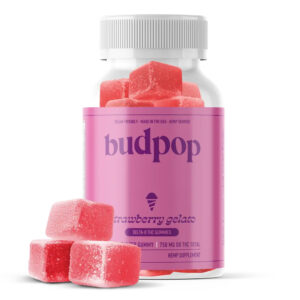
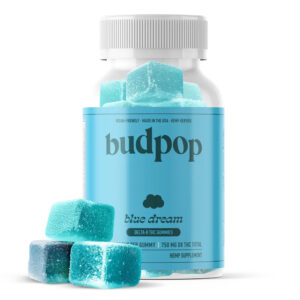
BudPop publishes Certificates of Analysis on every batch that cover potency, pesticides, heavy metals, residual solvents, and microbials. That five-panel testing is the standard a serious brand holds itself to. A lot of brands test for potency only and call it done.
Their hemp is grown in Colorado and Oregon under USDA oversight. The extraction is CO2-based. The gummy base uses pectin, not gelatin. The THC is naturally derived rather than synthesized.
The 96.7-grade reference comes from an independent consumer review aggregation. The figure reflects consistency: batch-to-batch potency variance that stays within 10 percent of the labeled dose. Most budget brands don’t publish enough COA data to calculate that variance at all.
The price premium over gas-station gummies is real, roughly 40 to 60 percent more per mg. The tradeoff is a product where you know what you’re actually taking.
The 2 stages where most cheap gummies cut corners
| Stage | Version | What actually happens |
| Extraction quality | Cheap route | Solvent-based extraction without a full purification run. Residual solvents stay in the extract and end up in the final product. A COA testing only for potency won’t catch this, you need a residual solvent panel specifically. |
| Extraction quality | Clean route | CO2 extraction or ethanol extraction followed by a full winterization and distillation run. Takes longer and costs more per batch, but produces a cleaner extract with a verifiable cannabinoid profile. |
| Third-party testing | Cheap route | Single potency test per product line, not per batch. Or no testing at all, relying on the supplier’s certificate rather than independent verification of the finished product. |
| Third-party testing | Clean route | Batch-specific testing from an ISO 17025 accredited lab, covering potency, pesticides, heavy metals, residual solvents, and microbials. Results published with a batch number you can match to the product you’re holding. |
Both of these are invisible on the label. A gummy that cut corners on extraction and skipped contaminant testing looks identical to a clean product at the point of purchase. The COA is the only way to tell them apart from the outside.
THC RECOVERY PICKS
Feeling Too High From Edibles?
These hemp-derived products are popular for promoting calmer,
smoother, and more manageable THC effects.
FAQ
Is there actual cannabis in a hemp gummy?
Hemp is cannabis. Specifically, it’s Cannabis sativa with a THC concentration at or below 0.3 percent by dry weight under federal law. A hemp-derived THC gummy contains cannabinoids extracted from the hemp plant. The molecule is identical to what you’d find in a marijuana-derived product. The only legal distinction is the source plant’s THC concentration at harvest.
Can I taste the THC in a gummy?
Usually not. The extraction and distillation process removes most of the terpenes and plant compounds that give raw cannabis its distinctive flavor. What you’re tasting in a well-made gummy is the flavoring added during the blend stage. Some full-spectrum products with retained terpenes have a faint herbal or earthy note, but it’s subtle.
How long do THC gummies stay fresh?
Most commercial gummies have a shelf life of 12 to 18 months when stored properly. Cool, dark, and dry is the formula. Heat degrades THC over time, converting it to CBN (which produces sedation more than euphoria). A gummy stored in a hot car for a week won’t be unsafe, but it’ll be weaker and may produce a different effect profile than when fresh.
Are all hemp gummies made in the US?
No. The hemp itself must be grown under USDA oversight to qualify as federally legal US hemp, but the manufacturing can happen elsewhere. Some brands import finished gummies from overseas manufacturers. A US-manufactured label is a different claim from US-grown hemp. Both matter. Look for both on the label or the brand’s website.
What’s the difference between a gummy and a capsule for THC delivery?
Both go through the same digestive process with roughly the same onset timeline. The main differences are precision and experience. Capsules give a more exact dose and no added sugars or flavors. Gummies are more pleasant to take for most people and often include flavoring that masks any extract taste. Onset and duration are comparable at the same mg dose.