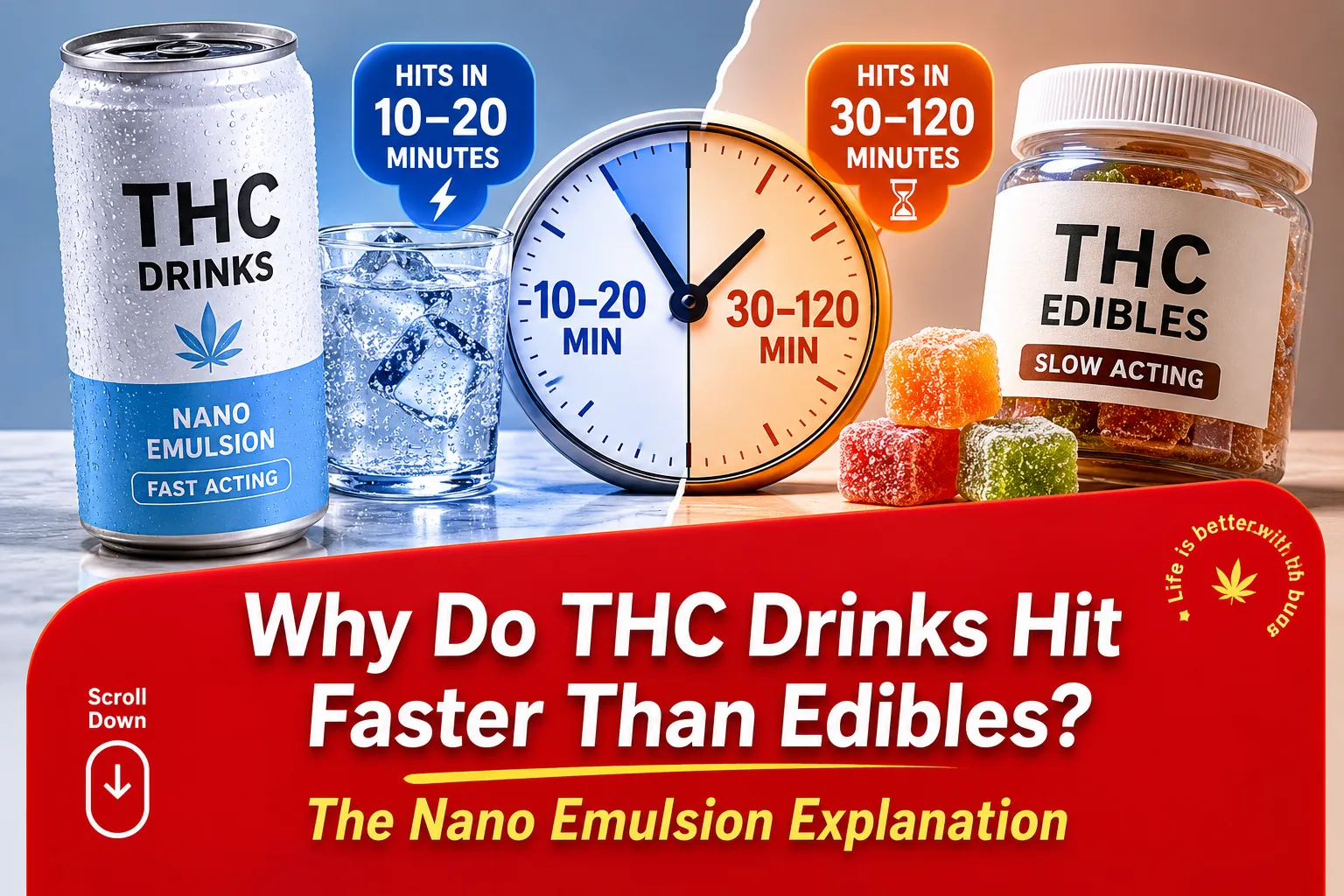
THC drinks hit faster than edibles because they use nano-emulsified THC, where the THC particles are broken down small enough to absorb directly through the mouth, throat, and stomach lining. Standard gummies must be processed by the liver first, which adds an hour. Drinks bypass the liver. That is the entire reason for the 15-minute onset.
If you’ve felt the difference between a seltzer and a gummy, you already know the headline. The science behind it is short, weird, and worth understanding once. Then you can pick the right format for your moment without second-guessing it.
Why is standard THC so slow (the liver pathway)
THC is fat-soluble. Water doesn’t dissolve it. Stomach acid doesn’t break it down efficiently. That’s the whole problem.
When you eat a gummy, the THC oil sits in the candy matrix. The gummy gets chewed, swallowed, and dropped into your stomach. From there, it has to pass through a few slow steps:
- Stomach: gummy dissolves over 30 to 60 minutes, releasing the THC oil
- Small intestine: oil mixes with bile, gets emulsified by your body’s own digestive enzymes
- Liver: blood from the gut runs through the liver first (the “first-pass effect”), where 80 to 94% of the THC gets metabolized
- Bloodstream: what survives reaches your brain and tissues
Total time from chew to feel: 30 minutes if you’re lucky, 2 hours if you ate a steak first.
Two things happen during that liver step that explain everything about edibles. First, the liver converts a chunk of THC into 11-hydroxy-THC, a metabolite that’s 2 to 3 times more potent than the original molecule and lasts much longer. Second, most of the dose you swallowed gets destroyed by liver enzymes before it even reaches your bloodstream. So gummies are slow and inefficient, but the bit that makes it through hits hard and lasts forever.
That long, heavy, dreamy edible high? That’s 11-hydroxy-THC. That’s the liver’s fingerprint on your high.
What nano emulsion actually does to a THC molecule
Nano emulsion is a 30-second physics lesson with a real outcome.
THC is a hydrophobic oil. Drop it into water and it forms big oily blobs that float on top. You can’t drink that. You can’t absorb it efficiently either, because absorption depends on surface area.
Nano emulsion solves this by using high-pressure or ultrasonic processing to mechanically shatter the THC oil into incredibly small droplets, typically 20 to 100 nanometers across. For reference, a human hair is about 80,000 nanometers wide. These droplets are 1,000 times smaller than that.
A surfactant (usually a food-grade emulsifier like lecithin or quillaja extract) coats each droplet, keeping them suspended in the water without clumping. The result is a stable, clear-ish liquid where the THC is evenly distributed at a molecular scale, ready to absorb.
Why the size matters:
- Small droplets have more surface area relative to volume
- More surface area means more contact with absorption sites in your mouth, throat, and gut
- More contact means faster diffusion across cell membranes
- Cell membranes are themselves fatty, so the surfactant-coated nano-droplets cross them easily
Think of it like the difference between throwing a single ice cube into your sink versus a handful of crushed ice. Same total amount of ice, way more surface for melting. Nano emulsion does that to the THC molecule before you even sip the can.
The mouth, throat, and stomach absorption pathway
Once the nano-emulsified THC hits your mouth, a chunk of it gets absorbed before you’ve even swallowed.
Three pathways are open to a sip of THC seltzer:
- Sublingual and buccal absorption. The tissue under your tongue and inside your cheeks is thin and rich in blood vessels. Nano-droplets can cross directly into your bloodstream here, bypassing the liver entirely. This is the fastest pathway, kicking in within 5 to 10 minutes.
- Throat and esophageal absorption. Less commonly discussed, but the lining of your throat and esophagus also absorbs nano-droplets directly into local capillaries. Another fraction of the dose enters your bloodstream this way.
- Direct stomach lining absorption. Nano-emulsified THC can cross the stomach wall and enter the bloodstream there, again bypassing the liver. This is much faster than the gummy pathway because the THC is already pre-emulsified and doesn’t need to be slowly extracted from a candy matrix.
What gets past all of that and reaches your small intestine? That portion still goes through the liver and produces some 11-hydroxy-THC. So a drink is a partial liver-bypass: roughly 30 to 50% of the dose skips the liver entirely, and the rest goes the slow way. That mixed pathway is why drinks feel different from both gummies and vapes.
The practical result: onset in 10 to 20 minutes for most of the dose, with a small extended tail from the portion that took the long route.
The bioavailability difference, why drinks are also more efficient
Bioavailability is the percentage of a dose that actually makes it into your bloodstream and reaches its target.
Here are the numbers across formats:
| Format | Bioavailability | Onset | Duration |
|---|---|---|---|
| Standard edible (gummy) | 6 to 20% | 30 to 120 min | 4 to 8 hours |
| Nano-emulsified drink | 20 to 40% | 10 to 20 min | 2 to 4 hours |
| Sublingual tincture | 12 to 35% | 15 to 45 min | 3 to 5 hours |
| Inhaled (vape/flower) | 30 to 56% | Under 5 min | 1 to 3 hours |
Standard edibles waste most of the dose to the liver. A 10 mg gummy might effectively deliver 1 to 2 mg to your bloodstream. A 10 mg nano drink might deliver 2 to 4 mg. That’s why drinks feel about the same intensity at half the milligram count, especially compared to older non-nano edibles.
Inhaled formats are still the most efficient, but they come with their own issues (lung exposure, smell, social stigma). Drinks are the most efficient option that still looks like normal social behavior.
Are nano drinks safer or less safe? Honest answer
This is the question I get from cautious customers, and it deserves a real answer instead of marketing copy.
The case that nano drinks are safer: predictable onset means fewer overdose accidents. The classic edible mistake is taking a gummy, feeling nothing for an hour, taking another, then having both land at once. Drinks remove that mistake because you know how you feel within 20 minutes.
The case that nano drinks could be less safe: nano-particle ingestion is a relatively new exposure route in human diets. Long-term safety data is thin. There’s ongoing academic debate about whether nano-sized food ingredients have different biological effects than their larger counterparts. The FDA has generally treated them as safe when made from food-grade materials, though that designation comes from short-term studies rather than decades of human data.
My honest read: the surfactants used in legitimate THC drinks (lecithin, quillaja, gum arabic) are common in regular food and beverages. The nano-droplets are made from compounds your body already processes. There’s no specific evidence of harm. But if you’re someone who avoids new food technologies on principle, this category is newer than gummies and the data is thinner.
For most people, the safety profile is fine. For the genuinely cautious, gummies have a longer track record.
What this means for dosing
The takeaway for your own use:
- Don’t carry your gummy tolerance to drinks. The faster, more efficient absorption means a 10 mg drink hits more like a 15 mg gummy at first.
- Drinks are easier to dose accurately because you feel the result within 20 minutes.
- Drinks end sooner, so you can have one with dinner and still drive home 3 hours later (where legal).
- Drinks bypass some of the 11-hydroxy-THC conversion, so the high feels clearer and shorter, less heavy and dreamy than a gummy of the same dose.
Start any new drink format at 5 mg, regardless of your edible experience. Move up after you’ve felt the curve once.
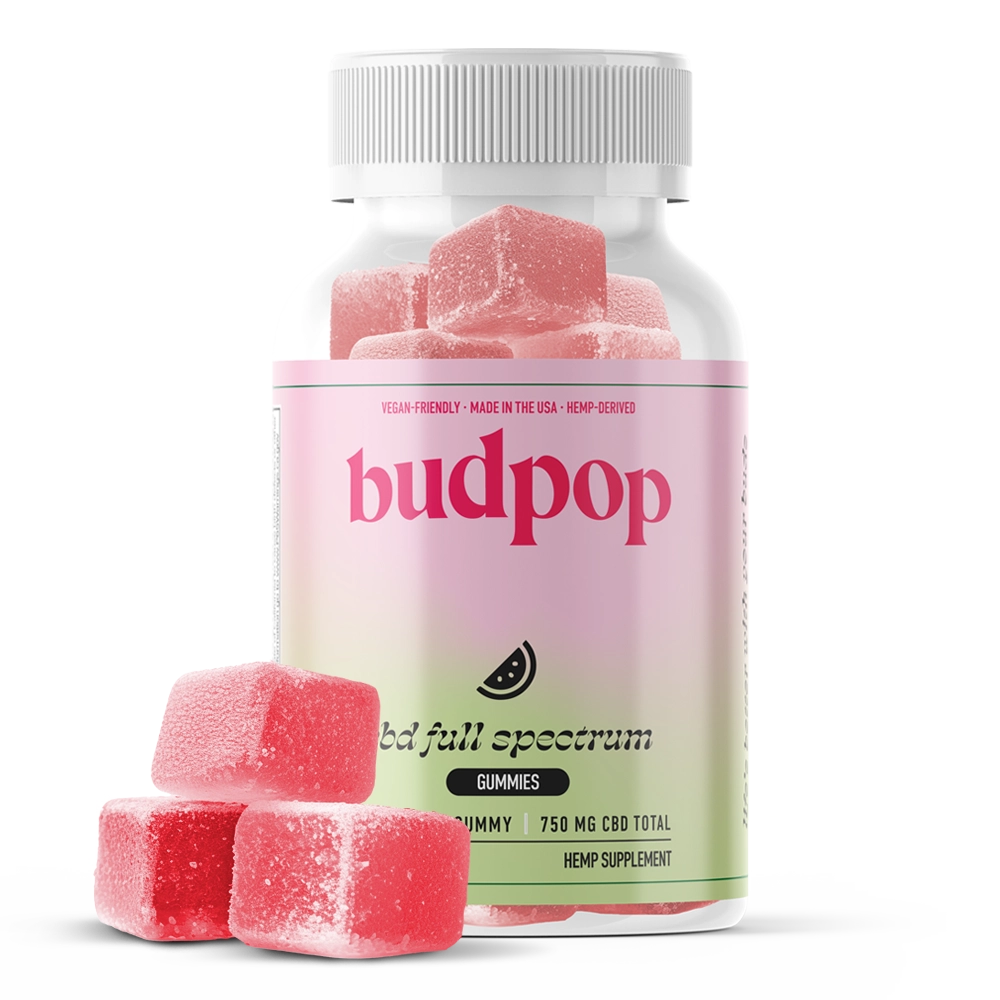
THC RECOVERY PICKS
Feeling Too High From Edibles?
These hemp-derived products are popular for promoting calmer,
smoother, and more manageable THC effects.
FAQ related to “THC drinks hit faster than edibles.”
Is nano-emulsified THC stronger than regular THC at the same dose?
Stronger in terms of bioavailability, yes. A 10 mg nano dose delivers roughly twice the active THC to your bloodstream compared to a 10 mg standard gummy. Stronger in terms of subjective high? Mixed. The drink feels faster and clearer. The gummy feels heavier and longer because of the 11-hydroxy-THC produced by liver metabolism. Same milligrams on the label, different experiences.
Can my body absorb nano THC through my skin?
Through unbroken skin, generally no, even with nano-emulsification. The outer layer of your skin (the stratum corneum) blocks most water-soluble compounds. Topical THC products mostly work locally on muscle and joint tissue without entering the bloodstream meaningfully. If a nano-emulsified topical did get absorbed systemically, that would actually be a problem for most users buying it for joint relief.
Why don’t all edibles use nano emulsion if it’s so much better?
Cost and texture. Nano emulsion adds equipment, time, and skilled processing to the manufacturing line. For a gummy, that cost increase is hard to justify when the slow, heavy high is what most edible buyers want. For a drink, where fast onset is the entire pitch, the cost is worth it. The format dictates the technology.
Will I test positive on a drug test from a nano drink?
Yes. THC is THC regardless of how it’s emulsified. Once it’s in your bloodstream, your liver eventually metabolizes it into THC-COOH, the same long-lasting metabolite that drug tests look for. Nano emulsion changes how fast it gets there and how much arrives, but the testing footprint is identical.
Where to go from here
If you’ve been confused about why a seltzer hits in 15 minutes and a gummy takes 90, this is the whole answer. Nano emulsion shrinks the THC molecule small enough to skip the liver. The liver is the slow, lossy step in edible absorption. Skip the liver, you skip the wait.
Try one nano drink with that science in mind and you’ll feel the curve described above almost exactly.