Why Is THCP Considered the Strongest Cannabinoid in 2026? A Complete Guide
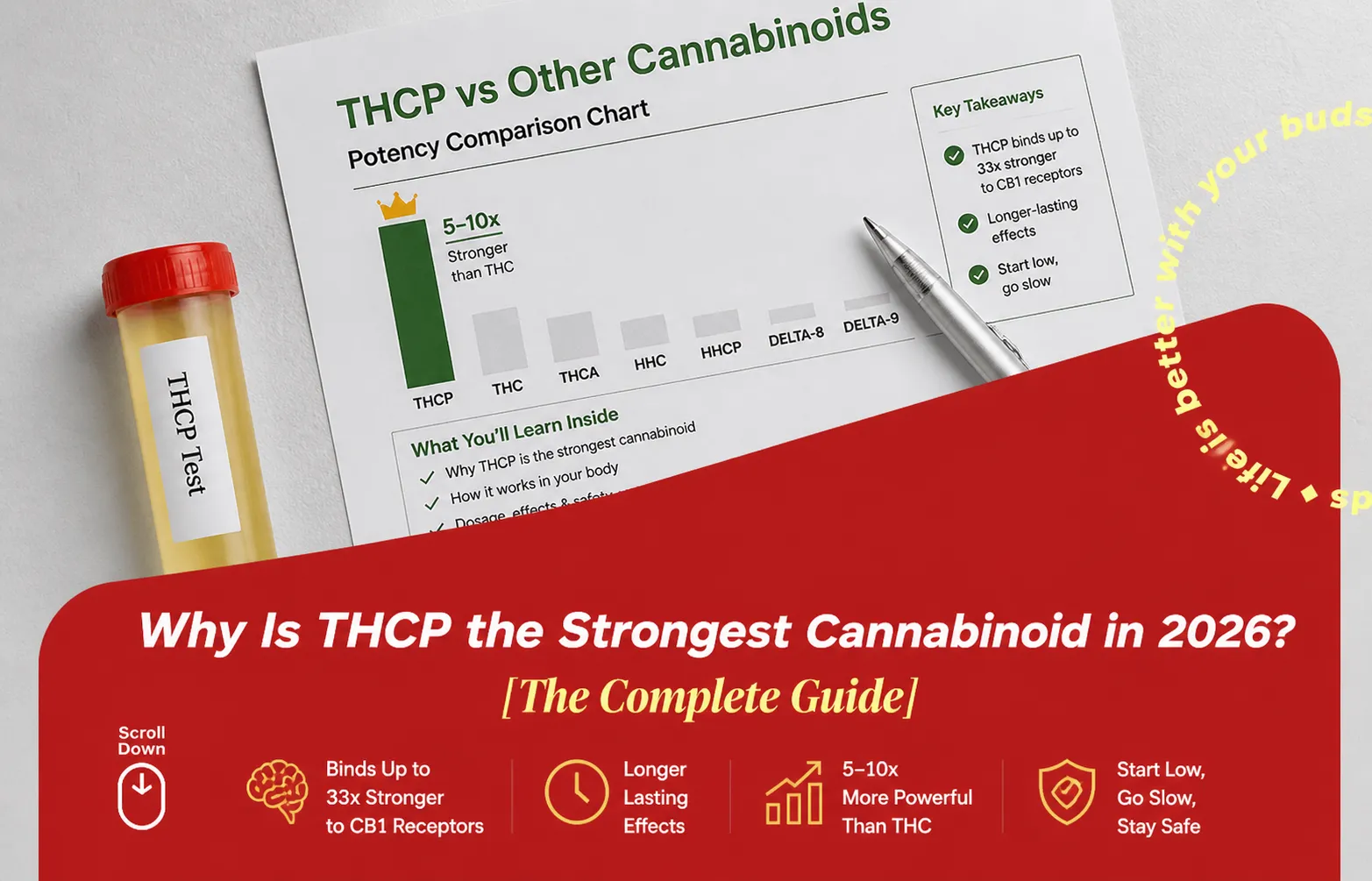
THCP keeps showing up on “strongest cannabinoid” lists, and people who try it usually agree. The reason it hits harder than regular THC isn’t marketing. It’s a tiny structural quirk that lets the molecule grip your brain receptors much more tightly. This complete guide covers why that matters for your first dose, what beginners get wrong, how THCP compares to every other cannabinoid on the market, and where the science actually stops being settled.
What This Guide Covers
This is a long-read guide. Use the section links below to jump where you need to go.
- The Cannabinoid Honesty Scorecard
- How THCP Actually Works in Your Body
- Why THCP Feels Stronger Than Regular THC
- How THCP Compares to THCA, HHC, HHCP, Delta-8 and Delta-9
- How Beginners Should Approach Their First THCP Experience
- Which THCP Product Format Should You Choose?
- The THCP Onset Timeline by Format
- Is THCP Legal Where You Live?
- How to Manage THCP Tolerance Long-Term
- Who Should Not Use THCP
- What We Don’t Know About THCP Yet
- Frequently Asked Questions
The Cannabinoid Honesty Scorecard
Before any of the marketing copy, here’s what the research actually supports about THCP today. Each claim is graded by the strength of the evidence behind it.
| Claim | Evidence Grade | Source |
| THCP binds to CB1 receptors roughly 33 times more tightly than Delta-9 THC | Strong Evidence | Citti et al., Scientific Reports (Nature), 2019. PMID: 31876848 |
| Real-world potency feels closer to 5-10x THC, not 33x | Emerging Research | Inferred from binding-affinity vs in-vivo data discussed in Citti et al., 2019; no human dose-response trial published |
| THCP produces longer-lasting effects than Delta-9 THC | Emerging Research | Citti et al., 2019 (mouse cannabimimetic activity) |
| THCP triggers a positive standard urine drug test | Strong Evidence | NIH National Institute on Drug Abuse, THC metabolite testing guidance |
| THCP causes faster tolerance build-up than THC | Anecdotal | User reports only; no controlled tolerance study published as of 2026 |
| THCP is safe for daily long-term use | Anecdotal | No long-term human safety data exists |
How Does THCP Actually Work in Your Body?
THCP and THC are nearly identical molecules with one important difference. Standard Delta-9 THC carries a five-carbon side chain on its alkyl tail. THCP carries a seven-carbon side chain in the same spot. That sounds like trivia, but it’s the entire reason this conversation exists.
That longer chain lets THCP slot into the CB1 receptor much more snugly. Citti and colleagues, in their 2019 Scientific Reports paper that first identified the molecule, measured a binding affinity (Ki value) of roughly 1.2 nanomolar for THCP versus around 40 nanomolar for Delta-9 THC. Lower numbers mean tighter binding. The math works out to about 33 times stronger receptor grip.
CB1 receptors live mostly in your central nervous system, which is why this binding strength matters so much. They modulate mood, perception, appetite, pain signalling, and short-term memory. When a molecule grabs CB1 harder and stays there longer, the felt effect is stronger and lasts longer. THCP does both at once.
It’s also a full agonist at CB1, not a partial one. Partial agonists activate the receptor but only to a portion of its potential signal. Full agonists push the receptor all the way. That distinction adds to the heavier subjective experience users describe and is part of why THCP feels qualitatively different rather than just like a stronger version of regular THC.
CB2 receptors, found mostly in the immune system and peripheral tissues, also bind THCP, though the relationship is less well characterised. Early research suggests THCP’s affinity for CB2 is also higher than Delta-9 THC’s, but the effects are subtler and less immediately psychoactive. Most of what you feel from THCP comes from CB1 activation in the brain.
Why Does THCP Feel Stronger Than Regular THC?
The 33x figure refers strictly to laboratory binding affinity. It does not mean a 5mg THCP gummy hits like 165mg of Delta-9. Real human experience is messier than the math, and that gap matters.
Most experienced users describe THCP as roughly 5 to 10 times more intense than Delta-9 at the same milligram dose. The ceiling effect is part of the reason. Once CB1 receptors are saturated, additional binding doesn’t translate to proportional additional intensity. So while THCP grips harder, the body has a maximum perceived signal it can produce.
The high also feels different in texture, not just in intensity. Reports consistently mention a heavier body load, slower onset for edibles, and a peak that arrives in waves rather than a single hill. Some people describe a low background warmth that pulses through the experience for hours after the cognitive peak fades.
Duration is the other big shift. A standard THC edible runs 4 to 6 hours for most people. THCP edibles often stretch to 6 to 10 hours, occasionally longer at higher doses. The same receptor-grip mechanism that drives the intensity also keeps the molecule active well past the timeline you might expect.
Plan your evening accordingly, especially with anything you eat. The biggest first-time complaint isn’t “too strong.” It’s “I had to be somewhere at 9am and I was still feeling it.”
There’s also the matter of metabolism. When you swallow a THCP gummy, your liver converts a portion of it into 11-hydroxy-THCP, a metabolite thought to follow the same pathway as 11-hydroxy-THC. That metabolite is widely understood to cross the blood-brain barrier more efficiently than the parent compound, which extends and intensifies the high beyond what the original dose would suggest. Vapes and tinctures skip most of this first-pass metabolism, which is why they feel faster but shorter.
Format matters as much as dose. A 5mg THCP vape draw and a 5mg THCP gummy will not feel identical, even at the same milligram count. The gummy will feel stronger and last longer. The vape will hit faster and fade sooner. Your first decision when buying THCP shouldn’t be “how much” but “in what form,” because the form changes the answer to how much.
There are a few common myths worth dismantling here. First, THCP is not synthetic in the way some marketing copy implies. It exists naturally in cannabis, just at trace levels (under 0.1%) too small to extract economically. The THCP in commercial products is converted from hemp-derived CBD using lab processes, but the molecule itself is identical to what the plant produces. Second, THCP is not a designer cannabinoid in the same category as Spice or K2, despite what occasional fearmongering articles suggest. Spice-class compounds are entirely synthetic CB1 agonists with no natural counterpart and dramatically different safety profiles.
Side effects scale with potency. Most THCP users at reasonable doses report effects similar to strong THC: dry mouth, red eyes, slight increase in heart rate, hunger, and slowed reaction time. At higher doses, anxiety becomes more common, particularly in users prone to it with regular THC. Paranoia, racing thoughts, and “green-out” episodes (nausea, dizziness, intense discomfort) are more frequent with THCP than with equivalent perceived-intensity Delta-9 doses, mostly because users misjudge the dose and overshoot.
If you experience an uncomfortable peak, the standard guidance applies: hydrate, lie down somewhere quiet, breathe slowly, and remember that the peak will pass. Acute THCP discomfort typically resolves within 2 to 4 hours, faster if you take CBD to soften the edge. There has never been a documented overdose death from THCP or any other cannabinoid, but uncomfortable hours are uncomfortable hours, and they’re entirely avoidable with correct dosing.
Related reading: How THCP compares directly to THC (/thcp-vs-thc/) | THCP vs THCA differences (/thcp-vs-thca/)
How Does THCP Compare to THCA, HHC, HHCP, Delta-8 and Delta-9?
Picking THCP off a shelf without context is a mistake. Every adjacent cannabinoid offers something different, and the right choice depends on what experience you actually want. Here’s how THCP stacks up against every major option you’ll see on the same product page.
| Cannabinoid | Relative Potency | Onset (Edible) | Duration | Best For |
| THCP | 5-10x THC | 60-120 min | 6-10 hours | Experienced users seeking maximum intensity and long duration |
| Delta-9 THC | Baseline (1x) | 45-90 min | 4-6 hours | Familiar, predictable experience for most users |
| THCA (smoked) | Roughly 1x THC after heat | N/A (smoked) | 2-3 hours | Users who prefer flower or vapes over edibles |
| HHC | 0.7-0.8x THC | 45-90 min | 4-6 hours | Smoother, milder high; better shelf stability |
| HHCP | Similar to THCP | 60-120 min | 6-8 hours | Slightly smoother THCP-equivalent; less anxiety risk for some users |
| Delta-8 THC | 0.5-0.7x THC | 45-90 min | 3-5 hours | Beginners, daytime use, lower-anxiety experience |
Read this table as a starting point, not a verdict. Tolerance, body chemistry, and the specific blend in any product all shift these numbers in real use.
Most THCP products on the market are blends rather than pure single-cannabinoid extracts. There’s a good reason for that. Pure THCP at meaningful doses is intense enough that newer users often have a rough first session. Blending it with Delta-8 or Delta-9 smooths the head pressure, slows the climb, and gives you a high that has THCP’s depth without its sometimes-overwhelming peak.
If you’re trying to decide between THCP and HHCP specifically, the choice often comes down to onset texture and shelf stability. HHCP is a hydrogenated version of THCP, which means hydrogen atoms have been added to saturate the molecule’s ring structure. This makes HHCP more resistant to oxidation, light, and heat (so it lasts longer in storage) and produces a slightly smoother experience for many users, particularly those prone to anxiety from high-CB1 activation. The trade-off is that HHCP feels marginally less intense at the same dose, which some users prefer and others find disappointing.
THCP vs Delta-8 is a different conversation entirely. Delta-8 is the gentle option for daytime, social, or beginner-friendly use. THCP is the heavyweight for evening, deep-relaxation, or experienced-user contexts. Buying both and using each in the right context is the strategy most experienced users land on, rather than picking one as a blanket choice.
If you’re coming from a background of regular Delta-9 use and curious whether THCP is worth trying, the honest answer is yes for the experience but not as a daily replacement. THCP at sensible weekly doses adds something real to your cannabinoid rotation. THCP as a daily Delta-9 substitute escalates tolerance fast and gets expensive.
Want to go deeper on specific comparisons? Is HHCP stronger than THCP? (/is-hhcp-stronger-than-thcp/) | Which cannabinoid hits hardest, ranked (/which-cannabinoid-hits-hardest-ranked/)
How Should Beginners Approach Their First THCP Experience?
The single most useful rule for THCP is to throw out your usual THC dosing instincts. They will get you in trouble, and the dose you respect with regular gummies is not the dose you want here.
A reasonable starting point for someone new to THCP is between 0.5mg and 1mg, regardless of how much THC you normally handle. Take it on a low-stress evening when you have no plans for the next 8 hours. Eat a small meal first, since edibles hit harder on an empty stomach and the gradual absorption helps soften the climb. Skip the alcohol pairing for your first try, because alcohol amplifies CB1 signalling and you want to feel the THCP response cleanly.
Wait at least 90 minutes before considering a second dose. THCP edibles can take longer to peak than standard THC, and stacking too early is the most common mistake first-timers make. The pattern is predictable: nothing happens at 30 minutes, the user takes another half-gummy, and then both doses peak together at the 2 hour mark with overwhelming results.
If you usually buy THCP in a blend (THCP plus Delta-9 plus THCA, which is how most products on the market are formulated), pay attention to the THCP milligram count specifically, not the total cannabinoid count. A gummy labelled “30mg total” might contain 25mg of Delta-9 and 5mg of THCP. The 5mg matters more for what you’ll actually feel during the peak, and it’s the number that should anchor your dosing decisions.
Track your sessions for the first month. Note the dose, the format, what you ate beforehand, the onset time, the peak intensity on a 1 to 10 scale, and the total duration. Patterns emerge fast, and within four sessions you’ll have a clearer personal dose response than any general guide can give you.
Have a CBD product on hand for your first few sessions. CBD doesn’t “cancel” THCP, but it does soften the edge if you find yourself climbing higher than you want. A 25mg CBD gummy or a few drops of CBD oil can take the sharp edges off without ruining the experience. Many experienced THCP users keep CBD nearby as a comfort backup.
Beginner-specific guides: How much THCP should a beginner take (/how-much-thcp-should-a-beginner-take/) | What happens when THCP meets a high THC tolerance (/what-happens-thcp-high-thc-tolerance/)
Which THCP Product Format Should You Choose?
THCP comes in four main formats: gummies, vapes (carts and disposables), tinctures, and infused flower or pre-rolls. Each one delivers the molecule differently, which changes the experience in ways that matter.
Gummies and Edibles
The most popular format and usually the best entry point for new users. Gummies give you a precise dose in a fixed milligram count, which removes one variable that newer users tend to mishandle. The downside is the long onset (60 to 120 minutes for most people) and the long tail (6 to 10 hours of meaningful effects). Edibles are the format where the 11-hydroxy-THCP metabolite plays its biggest role, which is why they feel disproportionately strong relative to inhaled formats.
Vape Carts and Disposables
Faster onset (10 to 20 minutes) and shorter duration (2 to 4 hours) make vapes the most controllable format for users who want to titrate their dose carefully. You take a single small puff, wait 15 minutes, and decide whether you want more. The catch is that THCP cart and disposable hardware varies wildly in quality, and a poor coil can ruin the experience or alter the actual dose you receive per puff.
Tinctures and Sublinguals
Tinctures held under the tongue for 30 to 60 seconds before swallowing produce a hybrid timeline: some absorbs sublingually for a faster onset (20 to 40 minutes), the rest swallows and produces an edible-style longer tail. Tinctures also let you fine-tune your dose by drop count. Less popular than gummies and vapes but useful for users who want precision without the wait of a gummy or the harshness of vapor.
Infused Flower and Pre-Rolls
Cannabis flower sprayed or dipped with THCP distillate, or pre-rolls infused with THCP diamonds. Onset is fast (5 to 10 minutes) but dose control is harder because you’re estimating based on draws and burn rate rather than measuring milligrams. Best for experienced users who already know their tolerance and want a traditional smoking experience with extra potency.
When Does THCP Actually Make Sense to Use?
Not every situation calls for the strongest cannabinoid on the shelf. THCP is genuinely useful in specific contexts and overkill in others. Here’s how experienced users tend to slot it into their routines.
For Sleep and Long Evenings
THCP shines when you have nowhere to be and want a deep, sustained relaxation that lasts the full night. The long duration that’s a drawback for daytime use becomes the main feature here. A small THCP dose 90 minutes before bed can produce 6 to 8 hours of deep rest, often with vivid dream activity that returns once tolerance permits. This is the most common reason regular users keep THCP in rotation.
For High-Tolerance Users Plateaued on THC
Users who’ve built significant tolerance to regular Delta-9 THC sometimes find THCP restores the depth they used to get from cannabis. The mechanism isn’t tolerance reset (THC tolerance still applies) but receptor activation through a different binding pattern. THCP can punch through a desensitised CB1 system in ways that simply taking more Delta-9 cannot.
For Pain Relief Sessions
Anecdotally, users dealing with chronic pain report THCP’s longer duration and heavier body load make it more useful than standard THC for evening pain management. No controlled clinical trials have validated this yet, but the binding-affinity data suggests stronger CB1 activation should produce stronger analgesic signalling. If you’re using cannabis specifically for pain, THCP is worth a careful trial.
Where THCP Doesn’t Make Sense
Daytime productivity, social settings where you want to stay clear, anything requiring driving or operating equipment, and any situation where you might need to be alert in the next 8 hours. THCP is the wrong tool for these. Delta-8 or low-dose Delta-9 are better-matched for daytime, social, or productivity-adjacent use because they fade faster and produce a lighter cognitive load.
What Does the THCP Onset Timeline Actually Look Like?
This is what to expect from a typical THCP gummy at a beginner-appropriate dose. Individual responses vary based on metabolism, body composition, recent food intake, and tolerance to other cannabinoids.
| Time After Dose | What You Should Notice |
| T + 15 min | Nothing yet. This is the danger zone where people redose. Don’t. |
| T + 30 min | Still likely nothing for most users. A faint warmth or relaxation may appear if you have low tolerance or didn’t eat. |
| T + 1 hr | First real signal. Mild head pressure, body warming, slight time distortion. Effects begin climbing. |
| T + 2 hrs | Approaching peak. Noticeable euphoria, deeper body relaxation, slower thought pace. This is when people who redosed at 30 minutes regret it. |
| T + 4 hrs | Full peak through descent. Heavy body load, possible couch lock at higher doses. Effects remain meaningful for several more hours. |
| T + 8 hrs | Tail effects fading but still present for many users. A pleasant residual relaxation often replaces the active high. |
| Next morning | Some users report a mild residual fog or grogginess, especially after higher doses. Hydrate and eat a normal breakfast. |
Note on individual variation: people with slower CYP450 enzyme activity often experience longer onsets and longer peaks. Body fat percentage also matters because THCP is highly fat-soluble and stores in adipose tissue, which affects how long traces remain detectable.
Need duration details? How long does THCP stay in your system (/how-long-does-thcp-stay-in-system/)
Is THCP Legal Where You Live?
THCP’s legal status splits cleanly into federal and state layers, and the two don’t always agree.
At the federal level, hemp-derived THCP containing less than 0.3% Delta-9 THC by dry weight falls within the framework set by the 2018 Farm Bill (Agricultural Improvement Act of 2018). That makes the cannabinoid federally legal when sourced from compliant hemp, even though THCP itself is far more potent than the THC limit suggests.
That federal picture changes on November 12, 2026. The Continuing Appropriations Act amendments (P.L. 119-37) shift the hemp definition from a Delta-9-only standard to a total-THC standard. After that date, any finished hemp product containing more than 0.4 milligrams of total THC per container loses its legal-hemp status. How exactly that rule applies to THCP-blended products remains unsettled and depends on FDA guidance still being drafted at the time of writing.
State law is where most users actually run into problems. Several states have explicitly banned or restricted THCP, including Alaska, Colorado, Delaware, Idaho, Montana, New York, Rhode Island, and Vermont as of early 2026. Other states such as Texas and Oregon have pending or recently passed legislation that may add or modify restrictions. State law can change quickly, often without much notice, and a product legal to ship in January may not be legal to ship in July.
Before buying, check three things: your state’s current hemp law, whether the brand will ship to your zip code (most reputable brands automatically check), and whether your state requires age verification or specific labelling. Reputable sellers will not process orders to states where their products are restricted, which is a small inconvenience that protects you from receiving illegal mail.
Stay current on legality: Is THCP legal in 2026 (/is-thcp-legal/) | Texas hemp laws 2026 (/texas-hemp-laws-2026/)
How Do You Manage THCP Tolerance Long-Term?
Most experienced THCP users report tolerance building faster than they’re used to with regular THC. The exact mechanism isn’t formally studied, but the leading hypothesis is straightforward: THCP grips CB1 receptors longer per dose, which means the receptors stay desensitised longer, which speeds up the body’s compensatory downregulation.
In practical terms, this is what most users notice. Daily THCP use leads to noticeably reduced effects within one to two weeks for most people. Users who started feeling intense effects from 2mg often need 5mg or more for the same experience after 30 days of daily use. The escalation is steeper than what users typically see with Delta-9 THC at equivalent timeframes.
The simplest tolerance management approach is spacing. Most experienced users rotate THCP into their schedule once or twice per week rather than daily, treating it as a special occasion rather than a routine. This keeps the receptors sensitive enough that smaller doses continue producing the experience they expect.
Cannabinoid rotation is the other useful tactic. Alternating THCP sessions with HHC, Delta-8, or even cannabinoid-free days lets specific receptor populations recover while others stay engaged. This isn’t a substitute for outright tolerance breaks, but it does slow the escalation curve for users who don’t want to fully abstain.
If you do reach a point where THCP no longer produces meaningful effects at reasonable doses, a 7 to 14 day full break (no cannabinoids of any kind) typically restores most of your sensitivity. Two days isn’t enough for most heavy users; 21 days is plenty for almost anyone. The receptor-recovery curve for THCP follows the same general pattern as for THC, just from a steeper starting point.
Diet and lifestyle play a small but real role in tolerance management. THCP is highly fat-soluble, so periods of fasting or aggressive exercise can mobilise stored cannabinoids from fat tissue and produce a mild, lingering background effect. This is why some heavy users notice a faint THCP-like feeling days after their last dose. Hydration, regular meals, and steady sleep don’t reset your tolerance, but they do support the body’s overall endocannabinoid balance, which makes the breaks you do take more effective.
If you’re combining THCP with other cannabinoids in any regular pattern, track them all. Tolerance to CB1 agonists generalises across cannabinoids: heavy daily THC use builds tolerance that affects how THCP feels, and vice versa. Users who think they’re “taking a break” by switching from Delta-9 to THCP every other day are not actually giving their receptors any recovery time. The break has to be from CB1 activation entirely, not just from one specific molecule.
Who Should Not Use THCP?
THCP is potent, novel, and under-researched in humans. Several groups should avoid it entirely or speak with a doctor first.
- Anyone pregnant or breastfeeding. The American College of Obstetricians and Gynecologists advises against any cannabis or cannabinoid use during pregnancy and lactation due to potential effects on fetal brain development.
- Anyone with a personal or family history of psychosis or schizophrenia. NIH research links high-potency THC to elevated risk of psychotic episodes in vulnerable individuals; THCP’s higher potency raises the same concern.
- Anyone taking blood thinners such as warfarin. THC and structurally similar cannabinoids can inhibit CYP2C9 and CYP3A4 metabolism, potentially raising warfarin levels.
- Anyone on benzodiazepines, opioids, or sedative-hypnotics. Combined CNS depression can be unpredictable and dangerous.
- Anyone with significant cardiovascular disease. THC and THCP can both increase heart rate and blood pressure during peak effects.
- Anyone facing a drug test in the next 30 days. THCP metabolises into THC-COOH, which standard urine tests detect.
- Anyone under 21. The brain continues developing into the mid-twenties, and high-potency cannabinoids are not appropriate during that window.
Source: NIH National Institute on Drug Abuse cannabis research summary; American College of Obstetricians and Gynecologists Committee Opinion 722 on marijuana use during pregnancy.
What We Don’t Know About THCP Yet
Honest disclosure matters more than confident-sounding marketing copy. Here’s where the science is genuinely thin.
- No long-term human trials longer than 6 months exist for THCP at any dose. Everything we know about chronic use is extrapolated from THC research or anecdotal.
- No published human dose-response curve. The 5-10x real-world potency estimate is informed guesswork from binding data, not from controlled human trials.
- Tolerance development timelines have not been formally studied. User reports suggest faster build-up than THC, but no peer-reviewed data confirms it.
- Specific drug interaction profiles for THCP have not been mapped. We assume similarity to THC at the CYP450 enzyme level, but THCP-specific interaction studies do not yet exist.
- Long-term cardiovascular impact at high doses is unknown. Acute heart-rate elevation is well documented for THC; cumulative effects of regular THCP use have not been studied.
BudPop Lab Note
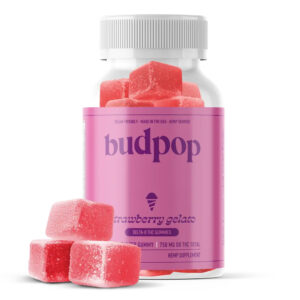
Lab Note from BudPop: Our D8 + D9 + THCP Strawnana Gummies use a measured 5mg of THCP per gummy in a blend with Delta-8 and Delta-9, because pure-THCP single-cannabinoid edibles are difficult to dose precisely for newer users. The Delta-8 in the blend smooths the head pressure that high-affinity CB1 binding can otherwise produce, and we publish the THCP-specific milligram count separately on every batch COA so you can dose by the cannabinoid that drives the experience, not just total cannabinoids.
How Do You Verify a THCP Product Is Actually What It Claims?
THCP is expensive to produce and easy to fake. The market has plenty of products labelled “THCP” that contain little or no actual THCP, leaning on the brand-name appeal to charge premium prices for cheaper cannabinoid blends. The only protection against this is reading the Certificate of Analysis (COA) before you buy.
A legitimate COA is a third-party lab document that lists, batch by batch, exactly how much of each cannabinoid is in the product. For THCP specifically, you want to see the THCP percentage or milligram count broken out separately, not lumped into a “total cannabinoids” number. If the COA only shows total potency without breaking out THCP individually, the product likely doesn’t contain meaningful THCP at all.
What a Real THCP COA Should Show
Five things, all clearly labelled and signed by an ISO-accredited third-party laboratory. First, batch number that matches the batch printed on your product. Second, individual cannabinoid breakdown including THCP, Delta-9 THC, Delta-8 THC, CBD, and any other compounds present. Third, contaminant testing covering pesticides, heavy metals (lead, arsenic, mercury, cadmium), residual solvents, and microbials. Fourth, the date of testing (older than six months should raise a flag). Fifth, the lab’s name and accreditation number, both verifiable through a quick search.
Red Flags That Tell You to Walk Away
In-house testing only (the brand tested itself; no third party verified the results). Vague “potency” numbers without specific cannabinoid breakdown. COAs hidden behind email signups or unavailable until after purchase. Mismatched batch numbers between product and document. Cannabinoid percentages that exceed what’s chemically possible (occasionally seen in fraudulent COAs that just multiply numbers to look impressive). Any of these signals means the product isn’t worth your money or your evening.
Most reputable hemp brands publish COAs directly on their website, indexed by batch number. You should be able to scan a QR code on the package or type the batch number into a search bar and pull the document immediately. If that’s not possible with the brand you’re considering, find another brand.
Frequently Asked Questions About THCP Strength
Is THCP really 33 times stronger than THC?
Not in real-world experience. The 33x figure refers to CB1 receptor binding affinity measured in a 2019 Italian lab study. In actual human use, THCP feels closer to 5 to 10 times stronger than Delta-9 THC, with longer duration and a heavier body load. Treat any product specifically by its THCP milligram count, not by comparison to THC.
How much THCP should a complete beginner take?
Between 0.5mg and 1mg as a starting dose, even if you have a high THC tolerance. Wait at least 90 minutes before considering a second dose. THCP edibles peak slower than standard THC, and stacking too early is the most common first-time mistake people make.
Will THCP show up on a drug test?
Yes. THCP metabolises into the same THC-COOH metabolite that standard urine drug tests detect. There is no way to use THCP and pass a standard drug screen, and THCP can stay detectable for weeks in regular users due to its high fat solubility.
Is THCP legal in the United States?
Hemp-derived THCP containing less than 0.3% Delta-9 THC by dry weight is federally legal under the 2018 Farm Bill. State laws vary, and a federal hemp redefinition takes effect on November 12, 2026, that may restrict total-THC content in finished products. Always check your state’s current rules before buying.
Why does THCP feel different from just stronger THC?
The longer side chain on the THCP molecule binds CB1 receptors as a full agonist with a much stronger grip than Delta-9 THC. That changes both the intensity and the texture of the experience. Most users report a heavier body high, slower onset, and longer-lasting effects rather than just a more intense version of a normal THC high.
Can you build tolerance to THCP quickly?
Most user reports suggest yes, faster than with regular THC, possibly because the receptor stays occupied longer per dose. No controlled study has confirmed the exact tolerance curve. Spacing THCP sessions 4 to 7 days apart is the most common harm-reduction approach experienced users follow.
Which THCP product format is best for beginners?
Gummies, because they offer a fixed milligram dose that removes guesswork. Vapes are technically more controllable per puff but require beginners to manage hardware quality, draw length, and timing. A blended THCP gummy with 2 to 5mg of THCP alongside Delta-8 or Delta-9 is the gentlest reliable entry point for someone trying THCP for the first time.
Can you mix THCP with alcohol?
Technically yes, but it’s a poor idea for newer users. Alcohol amplifies CB1 signalling and slows your ability to gauge the THCP onset accurately, which raises the chance of redosing too early. Wait until you’ve had at least three solo THCP sessions before pairing it with anything else, including alcohol or other cannabinoids.
THCP earns its reputation honestly. The molecule does what the lab data predicts, and most people who try it for the first time understand quickly why even small doses register. Treat it less like a familiar product and more like a tool you’re learning to handle. If you’re ready to try it with a measured, blended starting dose, BudPop’s D8 + D9 + THCP Strawnana Gummies make the entry point easier to control than a pure THCP single-cannabinoid edible.
Sources
- Citti, C., Linciano, P., Russo, F., et al. (2019). A novel phytocannabinoid isolated from Cannabis sativa L. with an in vivo cannabimimetic activity higher than Delta-9-tetrahydrocannabinol: Delta-9-Tetrahydrocannabiphorol. Scientific Reports, 9, 20335. PMID: 31876848.
- National Institute on Drug Abuse (NIH). Cannabis (Marijuana) Research Report. Available at: nida.nih.gov.
- American College of Obstetricians and Gynecologists. Committee Opinion No. 722: Marijuana Use During Pregnancy and Lactation.
- S. Food and Drug Administration. Regulation of Cannabis and Cannabis-Derived Products, including Cannabidiol. Available at: fda.gov.
- Agricultural Improvement Act of 2018 (Farm Bill), Subtitle G — Hemp Production. Public Law 115-334.
- Continuing Appropriations Act, P.L. 119-37 (2025), hemp redefinition amendments effective November 12, 2026.