Blue lotus (Nymphaea caerulea) is a water lily native to East Africa and the Nile region. Ancient Egyptians depicted it in temple art and tomb paintings, including on the body of King Tutankhamun. Scholars believe the flower was soaked in wine for ceremonial use, possibly at the Hathoric Festival of Drunkenness, a ritual involving intoxication, sleep, and a fleeting vision of Hathor, the goddess of love and fertility.
The flower contains two compounds that explain its calming reputation.
Apomorphine is a non-selective dopamine receptor agonist. It stimulates receptors responsible for feelings of reward, satisfaction, and ease. It was used as a sedative-hypnotic for insomnia as far back as the late 1800s and is still used today in injectable form for Parkinson’s disease.
Nuciferine is an aporphine alkaloid with a complex receptor profile. According to Farrell et al. (2016) in PLOS One, nuciferine acts as an antagonist at 5-HT2A serotonin receptors and a partial agonist at dopamine D2 and D5 receptors. It also inhibits the dopamine transporter.
Together, these two compounds quiet racing thoughts and create a gentle sense of contentedness. The to-do list stops scrolling through your head. The argument you replayed 40 times fades into the background. Blue lotus reduces the emotional urgency of the thoughts keeping you awake.
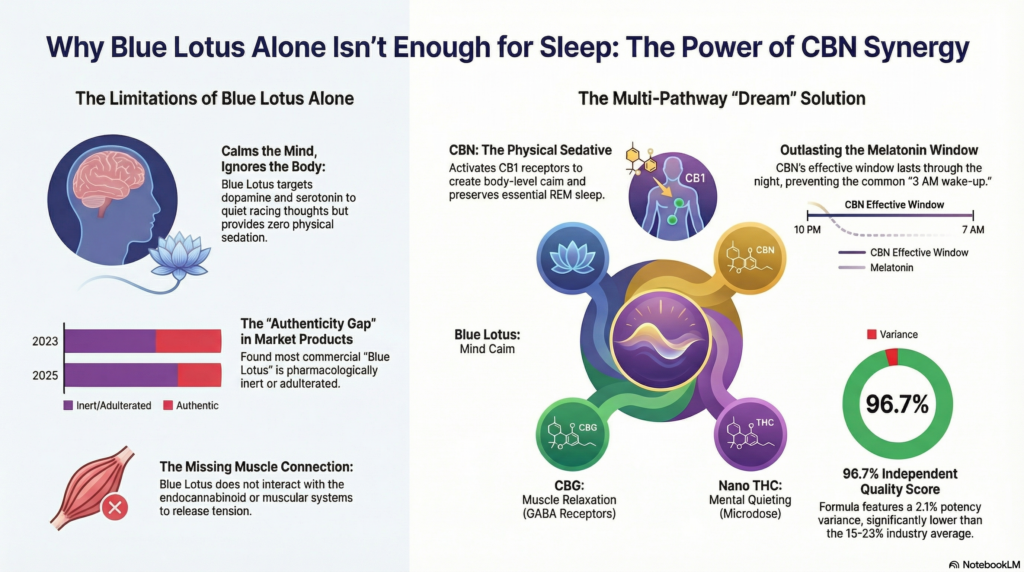
But here’s what blue lotus doesn’t do: it doesn’t create physical sedation. It doesn’t relax your muscles. It doesn’t address the body-level tension, the tight shoulders, the clenched jaw, the restless legs, that keeps you from actually falling asleep even after your mind has quieted down. Blue lotus works through the dopamine and serotonin pathways. It doesn’t interact with the endocannabinoid system, the muscular system, or the hormonal system.
That’s half a sleep solution. And for most people, half isn’t enough.
The Authenticity Problem Nobody Talks About
Before discussing what to add to blue lotus, there’s a harder question: is the blue lotus you’re buying even real?
In March 2025, UC Berkeley student researcher Liam McEvoy used mass spectrometry to compare authentic Nymphaea caerulea grown at the UC Botanical Garden with dried petals purchased from Etsy. The nuciferine levels in the verified specimens were significantly higher than in the commercially sourced flower. His conclusion: what’s sold online as “blue lotus” is likely a visually similar but pharmacologically inert water lily.
This echoes Ahmed et al. (2023), published in Molecules. That study tested 11 commercial blue lotus products and found that none matched authentic Nymphaea caerulea extracts in composition. Nuciferine and apomorphine were absent or present only in traces.
One Substack writer documented this gap firsthand after ordering a $20 bag of blue lotus petals from a Thai farm. After three nights of steeping flowers in tea and even trying coconut oil extraction, the effects ranged from “kind of calm” to nothing. Her conclusion, after weeks of reading the actual research: she was probably drinking a pretty, mostly inactive water lily dressed up in ancient branding. The species name on the label and the chemistry in the cup were not the same thing.
A separate case series in Military Medicine (Schimpf et al., 2023) raised an even more alarming concern: some products labeled “blue lotus” contained hidden synthetic cannabinoids, which caused altered mental status in five patients. Those weren’t traditional blue lotus effects. They were reactions to unlabeled adulterants.
The takeaway: sourcing matters as much as the ingredient itself. If you’re using blue lotus for sleep, you need verified extract from a manufacturer that tests every batch, not random dried petals from an unverified online marketplace.
Why CBN Completes What Blue Lotus Starts
Blue lotus calms the mind. CBN sedates the body. They work through entirely different biological systems, which is precisely why they work so well together.
CBN (cannabinol) is a minor cannabinoid that forms when THC ages through exposure to oxygen, heat, and UV light. It was the first cannabinoid ever discovered, isolated in 1896, 68 years before THC. CBN activates CB1 receptors in the endocannabinoid system, creating physical sedation. Its CB1 affinity is 5 to 10 times weaker than THC, which means it produces body-level calm without a perceptible “high.”
A 2024 study published in Neuropsychopharmacology (Nature) found that CBN increased total sleep time in animal models, including both NREM and REM sleep. That’s a rare quality. Most sleep aids, including melatonin and antihistamines, suppress REM sleep. CBN preserves it.
CBN is also particularly effective for sleep maintenance, staying asleep through the entire night. Its effective window outlasts melatonin’s 4 to 5 hour half-life, which is why CBN users report fewer 3 AM wake-ups.
A December 2025 meta-analysis in Sleep Medicine Reviews, covering over 1,000 participants, found that sleep benefits were driven specifically by THC and CBN formulations. CBD-only products showed no significant sleep effects. The combination approach, using cannabinoids that complement each other, produced better outcomes than any single compound.
The classic 1975 CBN study, cited by the Sleep Foundation, established this early: CBN alone showed little sedative effect at lower doses. But CBN combined with THC produced significantly stronger sedation than either compound alone. The synergy is real and has been documented for 50 years.
What Happens When You Combine Blue Lotus + CBN
Blue lotus and CBN address insomnia from opposite directions. Blue lotus resolves the mind half: racing thoughts, mental urgency, the inability to “shut off.” CBN resolves the body half: physical tension, wired nervous system, the inability to physically relax.
When taken together, the sequence plays out like this. Blue lotus’s apomorphine and nuciferine slow your thoughts through dopamine and serotonin modulation. Simultaneously, CBN’s activation of CB1 receptors in the endocannabinoid system creates physical sedation. Your mind quiets. Your body relaxes. Neither system is overloaded because the workload is split across two distinct pathways.
This is the fundamental design principle behind BudPop’s blue lotus gummies. Instead of relying on one ingredient to do everything (the melatonin model), the formula distributes sleep support across multiple biological systems.
Inside the Dream Gummies Formula: Every Ingredient, Every Pathway
Each Dream Gummy contains four active ingredients working through three non-hormonal pathways.
Blue Lotus Flower Extract: 300mg per gummy. Calms the mind through dopamine and serotonin. No hormonal interference. No tolerance buildup. Nuciferine’s 5-HT2A antagonism also affects REM sleep regulation, producing the vivid, colorful dreams that blue lotus users consistently report. No other sleep ingredient replicates this dream enhancement effect.
Nano CBN: 10mg per gummy. Sedates the body through the endocannabinoid system. Nano-emulsion breaks CBN into particles 25 to 100 nanometers wide, so more of each milligram actually reaches your bloodstream. 10mg nano CBN may be equivalent to 15 to 20mg of standard CBN. Onset is 30 to 45 minutes instead of the 60 to 90 minutes typical for standard edibles.
Nano Delta-9 THC: 2mg per gummy. A true microdose that quiets the last layer of mental noise without psychoactive intensity. At this dose, no perceptible “high.” During formulation testing, customers at 2mg reported “falling asleep naturally” compared to higher doses that caused morning grogginess. The THC is deliberately kept low because higher doses suppress REM sleep, the exact opposite of what the formula is designed to do.
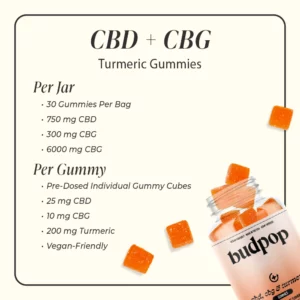
CBG: 10mg per gummy. Addresses the third pathway: physical tension. CBG interacts with GABA receptors and has anti-inflammatory properties that support muscular relaxation. Tight shoulders, clenched jaw, restless legs. CBG handles what CBN and blue lotus don’t directly target.
The result: mind calm (blue lotus), body sedation (CBN + THC), physical relaxation (CBG). Three pathways. Zero hormones. No melatonin.
Dream Gummies are vegan (pectin-based, not gelatin), cruelty-free, contain no artificial ingredients, and taste like mixed berry with a slightly tart finish. No herbal bitterness or aftertaste. 30 gummies per jar at $89.95, with up to 30% off when you subscribe.
How This Compares to Blue Lotus Alone
The difference between blue lotus tea and a multi-pathway formula shows up on two timelines: onset and duration.
Blue lotus tea alone: Variable potency depending on species authenticity and extraction method. Nuciferine is slightly fat-soluble and does not extract well into water. McEvoy’s UC Berkeley research suggests ancient Egyptians may have used oil infusion before adding lotus to wine, meaning a simple tea is likely the least effective preparation method. Effects, when present, are mental: reduced thought speed, gentle contentedness. No body sedation. Duration varies widely.
Dream Gummies: Standardized extract with verified potency. 300mg blue lotus per gummy, manufactured in cGMP-certified facilities and tested by ISO-certified third-party labs. Nano-formulated CBN and THC for 30 to 45 minute onset. Both mind calm and body sedation in a single serving. Effects last through the night because CBN’s window outlasts melatonin’s 4 to 5 hour half-life.
After testing Dream Gummies over several weeks, the timeline was consistent. Around 40 minutes in, the first shift arrives. Thoughts slow. Shoulders drop. Jaw unclenches. By 50 to 90 minutes, the full effect settles in: warm, calm contentedness paired with genuine physical relaxation. Not knocked out. Just ready. Morning after: clear-headed, no grogginess, no fog.
What Real Users Say About the Combination
Long-term user Diane Richardson put it simply: “I have been taking them for over a year now and they are the best if you can’t sleep.” That kind of repeat use, over twelve months of nightly consumption, speaks to consistency.
A shift worker with insomnia described the practical impact: “I struggle with insomnia and I work early shifts. These really help me get drowsy when its time for bed. I go to sleep within an hour and I always wake up well rested.”
Reviewer Vicki B. called them a “good clean product” that “helps me get quality sleep.” The word “clean” comes up often. Users notice the difference between a natural wind-down and products that leave a groggy or chemical residue.
Not every experience is identical, and transparency about that matters. Wendy Heeney noted she wakes at 3 AM and sometimes takes a second gummy. Jenna Hirte said she needs two for adequate sleep. Effects vary based on metabolism, body weight, tolerance, and the severity of the sleep issue.
BudPop scored 96.7 out of 100 in an independent evaluation across 47 Delta-9 brands (March 2026), with the lowest potency variance tested at 2.1% (industry average: 15 to 23%). Every jar includes a QR code linking to the Certificate of Analysis. Check what’s in your gummies at our lab testing page.
Drug test warning: Dream Gummies contain 2mg of Delta-9 THC. Even at this microdose level, nightly use will produce metabolite levels above the standard 50ng/mL cutoff within 1 to 2 weeks.
Want to see the full collection? Browse our blue lotus gummies and THC gummies categories.
Frequently Asked Questions
Does blue lotus actually help you sleep? Blue lotus calms the mind through dopamine and serotonin modulation, which can reduce the racing thoughts and mental urgency that keep you awake. However, it does not create physical sedation. For most people with genuine sleep difficulties, blue lotus works best when combined with a body-sedating compound like CBN, which is why BudPop formulated Dream Gummies with both.
How long does it take for blue lotus gummies to work? BudPop’s Dream Gummies use nano-formulated CBN and THC for faster absorption. Most users report the first subtle effects within 30 to 50 minutes. Full effects build over 50 to 90 minutes. Taking the gummy 45 to 60 minutes before your target bedtime, not when you’re already in bed frustrated, produces the best results.
Is blue lotus safe to take every night? Blue lotus research is still limited, and most evidence is anecdotal or from small studies. The FDA has not evaluated blue lotus for any medical use. Unlike melatonin, blue lotus does not work through the hormonal system, so there is no tolerance buildup from the blue lotus component. BudPop uses 300mg of standardized extract per gummy, manufactured in cGMP facilities with ISO lab testing. Consulting a healthcare professional before starting any nightly supplement is always recommended.
What’s the difference between blue lotus tea and blue lotus gummies? Blue lotus tea depends on the species authenticity and water extraction, which is a poor method for nuciferine (a fat-soluble alkaloid). Blue lotus gummies use standardized extract with verified potency, delivering a consistent dose per serving. BudPop’s Dream Gummies also combine blue lotus with CBN, micro-dose THC, and CBG for a multi-pathway formula that tea alone cannot provide.
Blue Lotus Is the Starting Point, Not the Finish Line
Ancient Egyptians understood something about this flower that most modern products miss: preparation matters, and a single ingredient rarely tells the whole story. Soaking lotus in wine was likely a multi-step extraction, not a simple tea. And the ceremonial use was almost certainly combined with other substances.
BudPop’s Dream Gummies honor that principle. Blue lotus provides the mind calm. CBN provides the body sedation. THC microdosing fills the gap between the two. CBG releases physical tension. Three pathways, one gummy, no melatonin.
Backed by a 30-day money-back guarantee. Free shipping on orders over $99. Subscribe and save up to 30%. If you don’t sleep better, send them back.
FDA DISCLOSURE: The statements regarding these products have not been evaluated by the Food and Drug Administration. These products are not intended to diagnose, treat, cure, or prevent any disease. Consult your health physician before use.