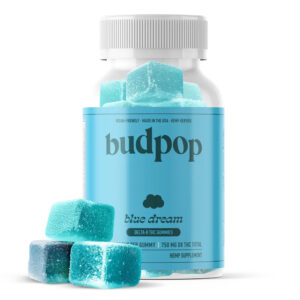
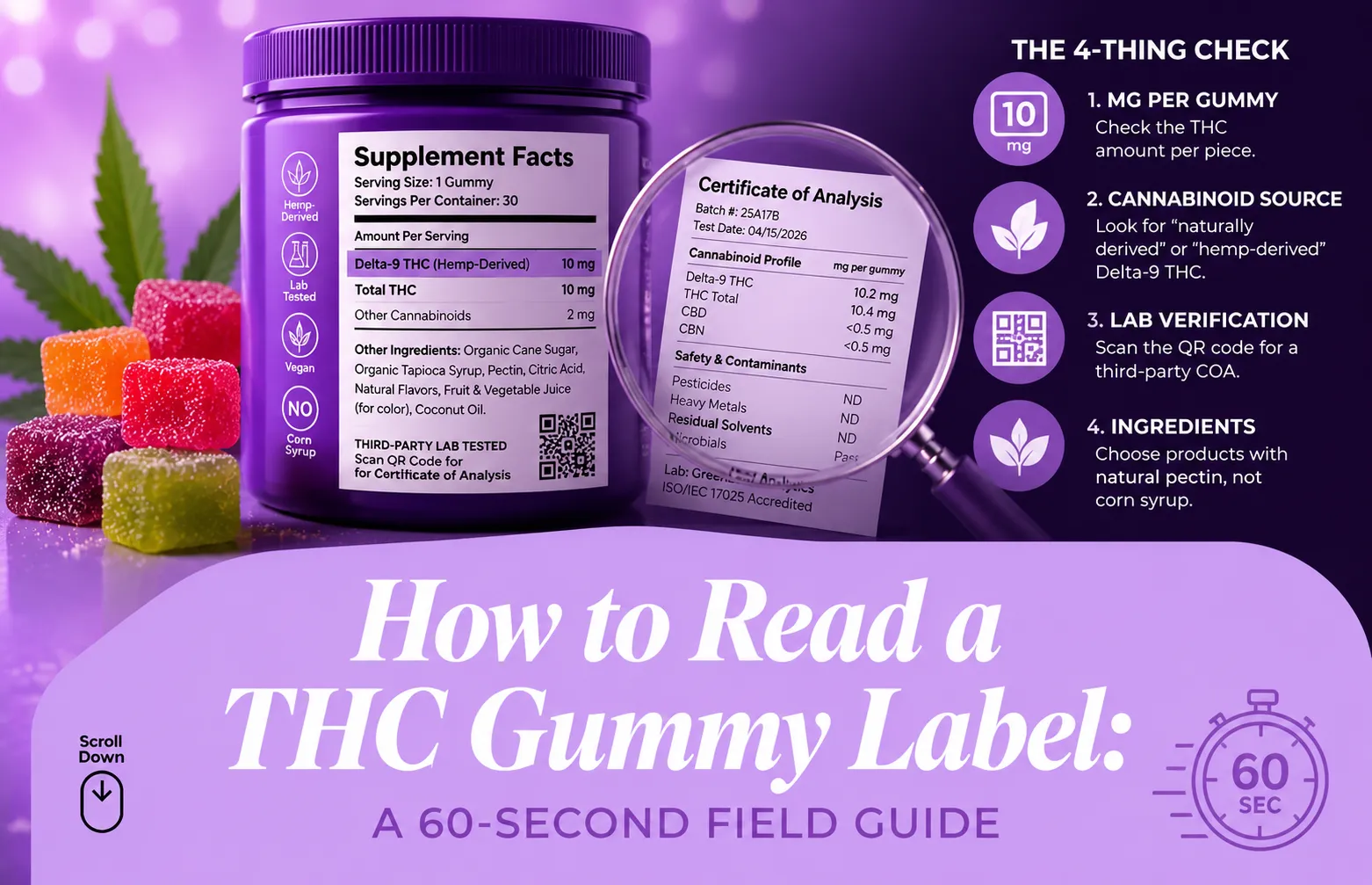
To read a THC gummy label, check four things. The mg of THC per gummy, not just per bottle. The cannabinoid source: naturally derived from hemp or synthesized from CBD. The QR code or batch number for the lab test. The full ingredient list, looking for natural pectin instead of corn syrup. If any of these are missing, don’t buy.
The four-thing check
Most people scanning a label in a store or online grab the price and the flavor and move on. That’s fine for a bag of chips. For a product that’ll alter your brain chemistry for 6 hours, four things actually matter.
- Mg per gummy. The dose per piece, not the total mg in the package.
- Cannabinoid source. Naturally derived from hemp or synthesized from another cannabinoid.
- Lab verification. A QR code or batch number that links to a third-party Certificate of Analysis.
- Ingredient list. What’s actually in it, and what’s being used as filler or binder.
If a label passes all four checks in under a minute, you’ve got a product worth buying. If one comes up short, there’s almost always a cleaner option at the same price point.
Per gummy mg vs total bottle mg: the most common misread
A bottle labeled “300 mg THC” is meaningless without knowing how many gummies are inside.
30 gummies at 10 mg each equals 300 mg. 12 gummies at 25 mg each also equals 300 mg. Take the wrong one expecting a mild 10 mg experience and you’ve taken more than double your intended dose.
Find the serving size line. It’ll say something like “Serving size: 1 gummy” followed by “THC per serving: 10 mg.” That’s the number that matters.
Some brands bury this. They put the total mg front and center because 300 mg sounds impressive, then list the per-serving breakdown in smaller text on the side panel. A brand confident in its dosing puts the per-gummy number front and center. That confidence (or lack of it) tells you something.
Naturally derived vs synthesized: why this matters in 2026
Hemp-derived Delta-9 THC comes directly from the hemp plant through an extraction and distillation process. The cannabinoid exists in the plant; manufacturers isolate and concentrate it.
Synthesized Delta-9 THC is produced through a chemical conversion process, typically starting with CBD. The end molecule is chemically identical to naturally derived Delta-9. But the synthesis process can leave behind byproducts depending on how well it’s executed, and the QA burden on the brand is higher.
The label language to look for: “naturally derived Delta-9 THC,” “hemp-derived Delta-9,” or “Delta-9 THC distillate from hemp.” Any of those is clear.
The language to be wary of: “hemp extract,” “cannabinoid blend,” or just “THC” with no sourcing details. Vague language usually means synthesized, or means the brand doesn’t want you asking the question.
A good COA will confirm the sourcing indirectly. Synthesized products sometimes show traces of CBD or CBN conversion byproducts at detectable levels. A clean, naturally derived product won’t.
The QR code on the label: what a real COA looks like
Scan the QR code before you buy. If there’s no QR code, look for a batch number printed somewhere on the packaging (usually near the bottom edge or on the back panel) and search it on the brand’s website.
A legitimate COA from an accredited lab has four things you can verify in about 30 seconds:
- The lab name and accreditation number. ISO 17025 accreditation is the standard. If the lab isn’t accredited, the test means very little.
- Cannabinoid potency results. This should list Delta-9 THC by mg per unit (per gummy), not just by percentage. Compare this number to what the label claims.
- Contaminant testing. Pesticides, heavy metals, residual solvents, and microbial testing should all show “pass” or “ND” (not detected). A COA covering potency only is a partial test.
- Batch number matches the label. The batch number on the COA should match the batch number on the product you’re holding. A generic COA posted once for the whole product line doesn’t prove anything about the batch you’re buying.
Some brands link COAs that are months or years old for products still on shelves. Check the test date. A COA older than 12 months is stale enough to be worth flagging.
Pectin vs gelatin: vegan and texture
This one matters less for potency but more for what you’re putting in your body and how the gummy behaves.
Pectin is plant-derived (usually from fruit peel). It produces a firmer, slightly more tart gummy. Vegan. Holds up better at room temperature.
Gelatin is animal-derived (from collagen). It produces a softer, chewier gummy with a more classic candy texture. Melts faster in heat and isn’t vegan.
Neither is inherently better from a THC delivery standpoint. But corn syrup as a primary sweetener in the ingredients list is worth noting. It’s cheap, it spikes blood sugar faster, and it’s a reasonable proxy for a brand cutting costs. Tapioca syrup or cane sugar is the cleaner alternative.
Natural flavors listed as an ingredient are fine. Artificial colors and flavors next to a list of chemical stabilizers suggest a product optimized for shelf life, not quality.
5 red flags that mean the brand is hiding something
| Red flag | What it means |
| No mg per piece listed | Some labels show only total mg per package. A package labeled “300 mg” could be 30 gummies at 10 mg each or 6 gummies at 50 mg each. If the label won’t tell you the dose per piece, you don’t actually know what you’re taking. |
| No QR code or batch number | Means no third-party testing, or the brand doesn’t want you verifying it easily. Either way, pass. |
| “Proprietary blend” in the cannabinoid section | A proprietary blend label hides the individual amounts of each cannabinoid. Brands use this to avoid disclosing that their “full spectrum” product has trace amounts of the minor cannabinoids they’re advertising. If they’re proud of the formula, they list it. |
| “Hemp extract” with no further detail | A good label says “hemp-derived Delta-9 THC” or “naturally derived Delta-9 THC from hemp.” Just “hemp extract” tells you nothing about how the cannabinoids were isolated or whether any synthesis was involved. |
| No listed manufacturer or address | Legitimate hemp products in the US have a manufacturer name and address on the label, or a website where that information is available. An anonymous product with no traceable origin has no accountability chain if something goes wrong. |
What a clean BudPop label looks like, side by side with a generic
The difference between a trustworthy label and a murky one shows up across 6 specific elements.
| Label element | BudPop (clean label) | Generic brand (murky label) |
| THC amount shown as | “10 mg Delta-9 THC per gummy” | “200 mg hemp blend” (20-count) |
| Cannabinoid source | “Naturally derived Delta-9 THC from US-grown hemp” | “Hemp extract” |
| Lab testing | Batch-specific QR code linking to third-party COA | No QR code; “tested for quality” printed on label |
| Ingredients | Tapioca syrup, cane sugar, pectin, natural flavors, Delta-9 THC distillate | Sugar, corn syrup, gelatin, “hemp blend,” artificial flavors, color additives |
| Manufacturer info | Full company name, address, website, and batch number | Brand name only; no address or contact info |
| Dosing guidance | “Start with 1 gummy (10 mg). Wait 2 hours before taking more.” | “Take 1 to 3 gummies as desired” |
The murky label isn’t lying, exactly. It’s just giving you as little verifiable information as possible. Every vague field is a place where the brand has declined to be accountable.
THC RECOVERY PICKS
Feeling Too High From Edibles?
These hemp-derived products are popular for promoting calmer,
smoother, and more manageable THC effects.
FAQ
What if the label says “up to 10 mg per gummy”?
“Up to” is vague on purpose. It means the gummy contains somewhere between 0 and 10 mg. A precise label says exactly 10 mg. Vague dosing language usually means inconsistent manufacturing. Skip it.
How do I find the COA if there’s no QR code?
Go to the brand’s website and look for a “lab results,” “testing,” or “COA” page. Search by product name or batch number. If you can’t locate the COA within 2 minutes of trying, the brand probably doesn’t publish them consistently. That’s enough of a reason to look elsewhere.
What’s the difference between “full spectrum” and “broad spectrum”?
Full spectrum means the product contains THC along with other cannabinoids found in the hemp plant. Broad spectrum means the THC has been removed (or reduced to trace amounts) while other cannabinoids remain. Isolate means only a single cannabinoid, usually CBD or THC. A label claiming “full spectrum” should list the THC content explicitly. If it doesn’t, the claim is unverifiable.
Can a label lie about the mg of THC?
Yes. Mislabeling is a known problem in the hemp market, which is exactly why third-party COAs exist. A COA from an accredited lab independently measures the actual cannabinoid content of the product. If the COA shows 8 mg and the label says 10 mg, that gap tells you something. Always cross-reference the label against the COA.
Does “organic” on the label mean anything?
In the US, USDA Organic certification applies to hemp. If the label says “USDA Organic,” that’s a real certification with standards behind it. If it says “all-natural” or “organic ingredients” without the USDA seal, it’s marketing language with no certification backing it.