Here is the short answer: Yes, Delta 9 THC is legal but in 32 states.
Here is the longer answer: it depends on where it comes from, how it was made, who made it, and which state you live in. And honestly, those details matter a lot more than most brands will tell you. Because the same three words, “Delta 9 is legal,” can mean a clean, fully compliant product arriving at your door in a few days or a sketchy bottle of synthetically converted sludge that happens to technically pass a label check.
This guide is going to take you through the whole thing. The history of why cannabis was ever illegal in the first place. The science behind what Delta 9 actually does in your body. The 2018 Farm Bill and why it changed everything. The state-by-state picture right now. The November 2025 federal update that most brands are still trying to quietly ignore. And what separates a brand you can actually trust from one you probably cannot.
By the time you are done reading this, you will know more about Delta 9 legality than most people who sell it. That is the goal.
Let’s Start With Why Cannabis Was Ever Illegal to Begin With
This part matters more than you might think. Because the legal history of cannabis in America is not a story of careful science and proportionate policy. It is a story of politics, racism, and decades of propaganda that eventually got untangled by the weight of economic reality.
Hemp was not just legal in Colonial America. It was encouraged. Early settlers were growing it for rope, sailcloth, paper, and clothing. In 1619, the Virginia Assembly actually required farmers to grow hemp. George Washington grew it at Mount Vernon. Benjamin Franklin used hemp to make paper. For the first couple of centuries of American history, nobody thought of cannabis as dangerous or deviant. It was just a useful plant.
That changed in the early twentieth century, and the reason it changed tells you a lot about how drug policy really works. Starting around 1910, as refugees fled the Mexican Revolution and settled in the American Southwest, they brought recreational cannabis use with them. The reaction from established communities was not curiosity. It was fear and prejudice. Between 1914 and 1925, 26 states passed cannabis prohibition laws. The rhetoric used to justify those laws almost always tied cannabis to Mexican immigrants, Black jazz musicians, or criminals. The goal was not public health. It was social control.
The Marihuana Tax Act of 1937 effectively made commercial hemp production nonviable by loading it with crushing taxation. By 1970, the Nixon administration put marijuana on Schedule I of the Controlled Substances Act, alongside heroin, listed as having no accepted medical use and high abuse potential. Internal documents later revealed that Nixon’s domestic policy chief John Ehrlichman admitted the War on Drugs was designed to target Black people and antiwar protesters. “We knew we couldn’t make it illegal to be either against the war or Black,” Ehrlichman told journalist Dan Baum, “but by getting the public to associate the hippies with marijuana and Blacks with heroin, and then criminalizing both heavily, we could disrupt those communities.”
This is the foundation on which modern cannabis law was built. Not evidence. Not proportionate risk assessment. Policy shaped by prejudice, maintained by inertia, and slowly dismantled by the mounting weight of research, economics, and changing public opinion.
California broke the seal in 1996 with the first state medical marijuana law. Colorado and Washington did it for recreational use in 2012. As of early 2026, 24 states plus Washington D.C. have recreational programs. 38 states have medical programs. And then there is the hemp lane, opened by the 2018 Farm Bill, which is what makes BudPop possible.
The 2018 Farm Bill: The Law That Changed Everything for Hemp
If you want to understand why you can order Delta 9 gummies online and have them delivered to your door without a dispensary visit, a medical card, or a government-issued permission slip, this is the law you need to understand.
The Agriculture Improvement Act of 2018, signed by President Trump in December of that year, did one very specific and very powerful thing: it drew a legal line between hemp and marijuana based on Delta 9 THC concentration. Cannabis plants with 0.3% Delta 9 THC or less by dry weight became legally defined as hemp. Hemp was removed from the Controlled Substances Act. It became legal to grow, process, sell, and ship across state lines. Hemp-derived products, including cannabinoids extracted from hemp plants, became federally legal.
The dry weight threshold is the mechanical detail that makes everything work. Because 0.3% sounds like almost nothing, and in a raw plant it is. But when you are making gummies, the finished product weighs a lot more than the tiny amount of cannabinoid inside it. A 10-gram gummy is mostly sugar, gelatin, flavoring, and water. The cannabinoid content is a small fraction of that total weight. So a 10-gram gummy can legally contain up to 30 milligrams of Delta 9 THC and still sit well below the 0.3% threshold. That is exactly how a meaningful edible dose becomes possible inside a federally legal product. This is not a loophole. This is the law working precisely as written.
The scale of what this bill unlocked is staggering. According to Whitney Economics’ 2023 National Cannabinoid Report, the U.S. hemp-derived cannabinoid market reached a conservative estimate of $28.4 billion. For context, that is the same size as the entire American craft beer market. Grand View Research projects the U.S. industrial hemp market will grow at 21.1% annually through 2030, reaching $6.22 billion. Cannabis Business Times reported that hemp-derived Delta 8 and Delta 9 sales grew 1,283% between 2020 and 2023, from $200 million to nearly $2.8 billion. These are not gray market numbers. This is a mainstream industry built on a clear federal framework.
What Delta 9 THC Actually Does In Your Body
Most articles skip this or give you a paragraph so thin it tells you nothing. But understanding the science here is what separates an informed consumer from someone just hoping for the best.
Your body has a system called the endocannabinoid system. It was discovered in the early 1990s when researchers were trying to figure out how THC produced its effects, and what they found surprised everyone: the human body already produces its own cannabinoid-like molecules. The endocannabinoid system did not evolve because people smoke cannabis. It evolved because the body needs it to regulate some of its most fundamental processes, including mood, sleep, appetite, pain perception, memory, and immune response.
The two main receptors in this system are called CB1 and CB2. CB1 receptors are distributed throughout the brain and central nervous system, concentrated in areas like the cortex, hippocampus, basal ganglia, and cerebellum. CB2 receptors are found primarily in immune tissues. A 2008 study published in PubMed documented that CB1 receptor activation plays a significant role in regulating sleep generation, which is part of why cannabinoids have become such an active area of sleep research.
Delta 9 THC is a partial agonist at CB1 receptors. This means it binds to and activates them, but not to the maximum possible degree. Research published in PMC on the pharmacology of cannabinoid receptors established that this partial agonism is part of why THC’s effects are dose-dependent and highly variable across individuals. The density and signaling efficiency of your CB1 receptors, your baseline endocannabinoid tone, your body weight, your metabolism, whether you have eaten, how much sleep you have had, the other cannabinoids present in the product all of these factors shape the experience.
When you swallow a Delta 9 gummy, it goes through your digestive system. The liver metabolizes Delta 9 THC into a compound called 11-hydroxy-THC, which is actually more potent than Delta 9 itself and crosses the blood-brain barrier more effectively. This is why edibles hit differently from smoking or vaping. The onset is slower (usually 30 minutes to 2 hours) but the effect is stronger, deeper, and longer-lasting, often running 4 to 8 hours. A study published in the journal Pharmacological Reviews on the role of the cannabinoid system in pain control confirmed that cannabinoid receptor agonists demonstrate antinociceptive (pain-reducing) and anti-inflammatory effects in both acute and chronic pain models, which explains why so many people reach for Delta 9 gummies specifically for pain and sleep.
Research from McLean Hospital, published in PMC, followed patients with anxiety disorders through a six-week trial using full-spectrum hemp-derived products and documented improvements in both clinical outcomes and cognitive measures. Full-spectrum products contain the whole range of cannabinoids present in hemp, including CBD, CBG, CBN, and trace Delta 9, working together in what researchers call the entourage effect. This is why a full-spectrum gummy can feel fundamentally different from a product built from isolated THC alone.
None of this means Delta 9 is for everyone or that it is without risks. At high doses or in people with certain sensitivities, it can cause anxiety, elevated heart rate, disorientation, and paranoia. A 2017 study published in Scientific Reports using fMRI and PET imaging showed that Delta 9 THC’s effects on anxiety are mediated through CB1 receptor availability in the amygdala, and that these effects are directly correlated with how many receptors a person has. Some people are neurologically wired to have a rough time with Delta 9 at high doses. Start low. Go slow. That advice is not a formality.
So Is Delta 9 THC Legal? Here Is the Full Picture
Federal law says yes. The 2018 Farm Bill is clear. Hemp-derived Delta 9 THC in products meeting the 0.3% dry weight threshold is federally legal to produce, sell, and ship.
But there is a layer underneath federal law that trips people up, and that is state authority. The 2018 Farm Bill explicitly preserved states’ rights to regulate hemp within their borders. Some states align closely with federal law. Others have added age requirements, potency caps, or licensing rules. A handful have essentially banned hemp Delta 9 products at the state level. Idaho, for example, maintains a zero-tolerance policy on all forms of THC including hemp-derived. Whatever the federal law says, Idaho is not playing along.
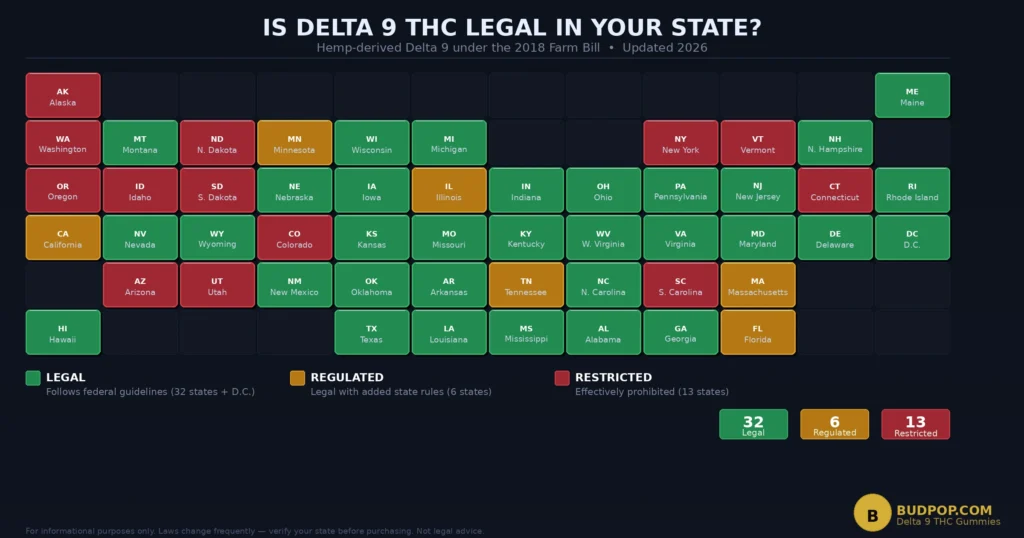
Below is the full state picture. Take a minute with this, because it is the most practically useful information in this article.
States Where Hemp-Derived Delta 9 Is Fully Legal
These states follow federal guidelines with no meaningful additional restrictions. You can purchase, receive, and possess hemp-derived Delta 9 gummies without any special requirements beyond being 21 or older:
Alabama, Arkansas, Delaware, Georgia, Hawaii, Indiana, Iowa, Kansas, Kentucky, Louisiana, Maine, Maryland, Michigan, Mississippi, Missouri, Montana, Nebraska, Nevada, New Hampshire, New Jersey, New Mexico, North Carolina, Ohio, Oklahoma, Pennsylvania, Rhode Island, Texas, Virginia, West Virginia, Wisconsin, Wyoming, and Washington D.C.
States With Additional Regulations
Legal, but with state-specific rules you should know about before buying:
California operates under AB-45, which caps total THC (not just Delta 9) and bans synthetic cannabinoids. Mandatory 21+ age verification. Florida passed regulations in 2025 requiring clear Delta 9 labeling, third-party testing documentation, and age-restricted sales. Illinois updated its hemp program with potency limits, child-resistant packaging requirements, and 21+ restrictions. Massachusetts requires stricter labeling, testing documentation, and enforces 21+ consistently. Minnesota implemented a 5mg per serving cap under 2023 hemp rules along with age restrictions. Tennessee introduced a full licensing and compliance framework in July 2024, requiring retailers to hold state licenses and verify 21+ age.
States Where Hemp Delta 9 Is Restricted or Effectively Prohibited
Idaho is the strictest: zero tolerance, any THC in any form is illegal. Alaska prohibits hemp-derived intoxicating products outside its licensed marijuana system. Arizona bans hemp THC products outside the state’s licensed cannabis program. Colorado has a 1.75mg per serving total THC cap that makes most hemp edibles non-compliant. Connecticut caps products at 5mg THC total per container. New York has strict per-serving limits that exclude most hemp edibles. Oregon restricts hemp intoxicants outside the licensed cannabis framework. South Carolina treats intoxicating cannabinoids as controlled substances under state law. South Dakota passed a 2024 law restricting chemically modified cannabinoids. North Dakota imposes significant regulatory barriers. Utah, Vermont, and Washington State each have frameworks that effectively route hemp THC into their licensed marijuana systems.
BudPop ships only to states where it is legally permitted to do so. This list is maintained and updated as state laws change. If you are in a restricted state, our checkout will reflect that. We will not ship to you and hope nobody notices. That is not how we operate.
The November 2025 Federal Update Nobody Told You About
On November 12, 2025, Congress passed P.L. 119-37, a full-year appropriations act that included provisions representing the most significant federal changes to hemp law since the 2018 Farm Bill itself. And most hemp brands have been conspicuously quiet about it.
Here is what changed. The federal definition of “hemp” was amended to measure total THC concentration against the 0.3% threshold, rather than just Delta 9 THC alone. That means THCA, Delta 8, and other THC-adjacent compounds now count toward the limit at the federal level. Additionally, the law introduces a hard cap: final hemp-derived cannabinoid products are limited to 0.4 milligrams of total THC per container.
The Senate Appropriations Committee stated plainly that these changes were intended to address what they called the “unregulated sale of intoxicating hemp products.” The provisions take effect in November 2026, giving the industry a transition window.
Why does this matter to you right now? Because products you buy today were formulated under the 2018 framework and remain fully legal during the transition period. But this update signals where federal policy is heading, and it makes the question of which brand you buy from far more important than it was three years ago. Brands built around the “any loophole works” mentality are going to face significant pressure. Brands built around genuine compliance have less to worry about.
BudPop’s formulation team was tracking this legislation before it passed. All products are formulated with the transition in mind.
The Ugly Truth About How Most Hemp Delta 9 Is Actually Made
This is the section most hemp brands really do not want you to read. But it is important, and it is one of the things that genuinely separates BudPop from a significant chunk of the market.
A 2023 analysis reported through NORML found something striking: only about 18.4% of hemp-derived Delta 9 products evaluated on the market probably used naturally extracted Delta 9 THC from hemp plants. The majority were almost certainly made by chemically converting CBD into Delta 9 THC in a lab using acids and solvents, then calling it “hemp-derived” because the starting material was hemp-derived CBD.
Is that technically legal under the 2018 Farm Bill? In a narrow sense, courts have upheld that it can be. But is it what consumers think they are getting when they see “hemp-derived Delta 9” on a label? Almost certainly not. Natural Delta 9 from hemp is expensive and rare because hemp plants contain very little of it. Chemically converting CBD is cheaper and easier. The resulting product can contain residual solvents, chemical byproducts, and conversion artifacts for which there is essentially no long-term safety data.
BudPop uses naturally derived hemp Delta 9, not synthetic conversion products. The COA will show you this. Every batch is tested by an independent, ISO-certified laboratory (Canalysis Laboratories, based in Henderson, Nevada) for cannabinoid content, residual solvents, pesticides, heavy metals, and microbial contamination. A 2024 study published in Frontiers in Pharmacology found that a substantial portion of hemp CBD products on the market contained pesticide, solvent, and heavy metal violations. Choosing a brand with transparent, accessible lab results is the single most important thing you can do as a consumer. Not just for Delta 9 but for any hemp product you put in your body.
Those COAs are not buried somewhere on a website. They are accessible via QR code on every BudPop package.
What Happens When You Actually Order
This is what a lot of people searching “is Delta 9 legal” really want to know. Not the theory. The reality. What actually happens when you place an order?
BudPop processes almost all orders within 24 hours. Standard shipping takes 5 to 7 business days on average. Express options are available. Orders arrive in discreet packaging with no exterior labeling that indicates the contents. You get a tracking number in your shipping confirmation email. That is it. There is no drama at the door. There are no customs issues. There is no neighbor giving you a suspicious look because of what the package says on the outside.
This is not BudPop’s claim. It is what customers keep saying themselves.
“BudPop’s Delta 9 product is equal to any I’ve tried and their shipping schedule always gets our gummies delivered just as we are getting concerned we’ll run out.” (Trustpilot)
“I love BudPop. I have had a few orders and the shipping is fast and the quality is excellent. That’s saying a lot with so many vendors out there that are unreliable.” (Trustpilot)
“Consumers are also pleased with the order and fast delivery service, with some noting that their orders were shipped within an hour and arrived quickly in discreet packaging.” (Trustpilot review summary)
“I really enjoyed the experience. It left me calm and focused.” (Trustpilot)
“This is my second time ordering CBD tincture from Budpop, and I highly recommend it for people with arthritis. It has helped me manage my pain and feel comfortable.” (Trustpilot)
Customers across Texas, North Carolina, Georgia, Indiana, Ohio, Kentucky, Virginia, and dozens of other legal states have received their orders without incident. Because hemp-derived Delta 9 in compliant products is legal. The USPS and private carriers do not intercept or inspect compliant hemp packages. This is not marijuana. This is a federally legal product operating under a clear regulatory framework, shipped the same way vitamins and supplements ship.
The one thing that changes your experience is which state you are in. If you are in Idaho, BudPop will not ship to you. If you are in Colorado or Connecticut, the per-serving caps mean the products we sell would not be compliant with your state law. Our checkout is built to catch this. You will not get a surprise rejection after you have already paid.
The BudPop Difference: Something Only We Can Show You
Every hemp brand says they test their products. Every brand says they use quality hemp. Every brand says they care about compliance. So let’s talk about something concrete that only BudPop can show you.
In the early days of BudPop, before the product range had expanded into what it is today, the team ran a product sampling program. 400 packets of 20mg Delta 9 gummies were sent out free to early customers. No purchase required. No upsell. Just: try this and tell us what you think.
80% of the people who responded said they got completely baked.
That is not a complaint. Most of them loved it. But a significant number had experience with cannabis before, had some experience with hemp products, and still were not prepared for the potency of a 20mg Delta 9 edible. The feedback was specific and consistent: the product worked, worked well, and at 20mg, worked harder than expected for people who had never really taken a serious edible before.
Here is what BudPop did with that information: instead of quietly adjusting the formula downward and hoping nobody noticed, they expanded the product range to reflect what the data actually showed. That data told us that people come to Delta 9 gummies from all different starting points. Some are experienced cannabis consumers looking for a strong, reliable effect. Some are complete beginners who tried their first edible in their 40s because a friend recommended it and they have not smoked anything in twenty years. Some people want 5mg. Some want 25mg. Some want a slow-burn indica for sleep. Some want a bright, energetic sativa for a Saturday afternoon.
The current BudPop lineup is built around that real-world feedback, not around what a product manager thought would look good on a shelf. The nano-enhanced gummies for people who want faster onset and lower doses. The sleep gummies combining Delta 9 with CBN and melatonin for people who came to us specifically for rest. The Live Resin gummies for people who want the full terpene profile of a specific cannabis strain in an edible form. The high-potency options for people who know exactly what they are doing and want it done properly.
That 400-packet experiment is something only BudPop ran. The data it produced is something only BudPop has. And the product range it generated is evidence that this brand actually listens to the people buying from it.
Why BudPop Will Always Be #1 When It Comes To Legal Delta 9 THC
Bold claim. Here is exactly what backs it up.
The hemp is American-grown. BudPop sources from domestic hemp farms operating under USDA oversight. The raw material is cultivated legally, regulated consistently, and traceable from seed to product.
The Delta 9 is naturally derived, not synthetically converted. As noted above, the majority of the market uses chemical conversion of CBD into Delta 9. BudPop uses naturally extracted hemp Delta 9. This is more expensive and more complex. It is also more honest about what you are actually consuming, and more likely to remain legally unambiguous as regulations tighten.
Every batch is independently lab tested before it ships. Canalysis Laboratories, an ISO-certified facility in Henderson, Nevada, tests every BudPop production batch for Delta 9 concentration, total cannabinoid profile, residual solvents, pesticides, heavy metals, and microbials. Products that fail do not ship. Products that pass have a publicly accessible COA tied to the batch number on the package. You can scan the QR code right now and verify the lab results on the exact batch you are holding. Most brands cannot offer that level of traceability.
Manufacturing happens in cGMP-certified facilities. Current Good Manufacturing Practice is the standard pharmaceutical companies operate under. It covers everything: raw material sourcing, production environment controls, equipment calibration, quality control documentation, and employee training. It is not the minimum standard. It is the serious standard.
The formulation team tracks regulatory changes proactively. The November 2025 federal amendment did not catch BudPop off guard. The legal and formulation teams monitor state and federal legislative developments as a core business function. When laws change, products adapt. When a state tightens restrictions, the shipping policy updates. This is compliance treated as a value, not an afterthought.
BudPop only ships where it is legal to ship. This sounds obvious but it is not the industry standard. Plenty of brands ship to restricted states and rely on the relative novelty of the category to avoid scrutiny. BudPop does not. The checkout system reflects current shipping restrictions by state. If your state is on the restricted list, you will know before you enter your payment details.
These are not promises. They are structural commitments that are either true or demonstrably false. You can verify the lab results. You can check the manufacturing credentials. You can look up the state shipping policy. The evidence is public and available. That is what accountability looks like.
Hemp vs. Marijuana Delta 9: Clearing Up the Confusion
A question comes up constantly: if the molecule is the same, why does it matter where it comes from?
It matters legally. Chemically and biologically, you are right. Delta 9 THC extracted from hemp and Delta 9 THC extracted from marijuana are the same molecule. Identical atomic structure. Identical mechanism of action. Your CB1 receptors respond the same way to both at equal doses. The plant label does not follow the molecule into your bloodstream.
The difference is regulatory and, by extension, practical. Here is what that looks like:
| Hemp-Derived Delta 9 | Marijuana-Derived Delta 9 | |
|---|---|---|
| Federal status | Legal (up to 0.3% by dry weight) | Schedule I controlled substance |
| Can be shipped online | Yes, to legal states | No, cannot cross state lines |
| Requires dispensary | No | Yes |
| Credit card accepted | Yes | Usually no (most dispensaries cash only) |
| Medical card required | No | In medical-only states, yes |
| Effect at same dose | Identical | Identical |
| Drug test result | Positive (same metabolites) | Positive (same metabolites) |
That last row is important enough to say clearly: hemp-derived Delta 9 will show up on a standard drug test. There is no way around this. Standard immunoassay tests detect THC-COOH, the primary metabolite of Delta 9 THC. They cannot distinguish between hemp-derived and marijuana-derived sources. Occasional use typically clears in 3 to 7 days. Regular use can take 30 days or longer. Heavy daily use can show up for 90 days or more. If workplace drug testing is part of your life, this is information you need before you order anything.
Frequently Asked Questions
Is Delta 9 THC federally legal?
Yes. Hemp-derived Delta 9 THC is federally legal under the 2018 Farm Bill as long as it is derived from hemp and the finished product contains no more than 0.3% Delta 9 THC by dry weight. Marijuana-derived Delta 9 THC remains a Schedule I federal controlled substance. State laws vary, and a handful of states have enacted restrictions that limit or prohibit hemp Delta 9 products.
Is Delta 9 legal in all 50 states?
No. While hemp-derived Delta 9 is federally legal, states have the authority to impose their own restrictions. Idaho has a zero-tolerance policy on all THC including hemp-derived. States including Alaska, Arizona, Colorado, Connecticut, New York, North Dakota, Oregon, South Carolina, South Dakota, Utah, Vermont, and Washington State have enacted laws that restrict or effectively prohibit hemp Delta 9 products. Most states follow federal guidelines and permit them freely.
Can you order Delta 9 gummies online and have them shipped to your house?
Yes, in states where hemp-derived Delta 9 is permitted. BudPop ships to all legally permitted states. Orders process within 24 hours, arrive in discreet packaging, and include tracking. No dispensary visit, medical card, or special documentation is required. Payment by credit or debit card is standard. BudPop does not ship to states where it is not legally permitted to do so.
Will Delta 9 gummies show up on a drug test?
Yes. Standard drug tests detect THC metabolites and cannot distinguish between hemp-derived and marijuana-derived sources. Occasional use typically clears within 3 to 7 days. Regular use can take 30 days or more. If you face workplace drug testing, avoid all Delta 9 THC products regardless of their legal source.
What changed with the federal hemp law update in November 2025?
P.L. 119-37, passed November 2025, amended the federal definition of hemp to measure total THC (not just Delta 9) against the 0.3% dry weight threshold. It also capped final hemp-derived cannabinoid products at 0.4mg of total THC per container. These provisions take effect November 2026. Products sold today under the 2018 Farm Bill framework remain legal during the transition period.
Why do hemp Delta 9 gummies get you as high as dispensary products?
Because the Delta 9 THC molecule is chemically identical regardless of source. A 20mg hemp Delta 9 gummy and a 20mg marijuana Delta 9 gummy will produce the same effect because they contain the same molecule at the same dose. The “hemp” label refers to the source plant and the legal pathway, not a modified or weakened version of THC. The dry weight rule allows meaningful milligram amounts to be delivered in a gummy while remaining within the 0.3% concentration threshold.
Do I need a medical card to buy Delta 9 gummies from BudPop?
No. Hemp-derived Delta 9 exists outside the state medical marijuana system. No medical card, physician recommendation, qualifying condition, or dispensary visit is required. You need to be 21 or older and in a state where BudPop ships. That is it.
What is the 0.3% dry weight rule and why does it matter?
The 2018 Farm Bill defines hemp as cannabis with no more than 0.3% Delta 9 THC by dry weight. “Dry weight” refers to the total weight of the finished product after moisture is removed. Because gummies contain mostly sugar, gelatin, and flavoring, their total weight is much higher than the cannabinoid content. A 10-gram gummy can legally contain up to 30mg of Delta 9 THC and remain below 0.3%. This is what makes meaningful edible doses possible in a federally legal product.
Is it safe to buy Delta 9 gummies online?
It depends entirely on the brand. A 2024 study published in Frontiers in Pharmacology found that a significant portion of hemp products on the market contained pesticides, heavy metals, and residual solvents in violation of safety limits. Buying from a brand that provides batch-specific Certificates of Analysis from an ISO-certified third-party laboratory, manufactured in cGMP-certified facilities, and ships only to legal states is the way to do this safely. BudPop meets all three criteria.
What is the difference between hemp Delta 9 and marijuana Delta 9?
The molecule is chemically identical. The difference is the source plant, the legal framework, and the shopping experience. Hemp-derived Delta 9 comes from plants with 0.3% or less THC and is federally legal. It can be ordered online, paid for by card, and shipped across state lines. Marijuana-derived Delta 9 comes from higher-THC plants, remains federally illegal, cannot cross state lines, and requires a dispensary in states where it is legal recreationally or medically. Both produce the same effects at the same dose.
Legal disclaimer: This article is written for educational and informational purposes only. It does not constitute legal advice. Hemp and cannabis laws change frequently and vary by state. Always verify your state’s current regulations before purchasing. BudPop ships only where legally permitted. This article is not medical advice. Consult a licensed healthcare professional before beginning any supplement or cannabinoid regimen. Do not drive or operate machinery after consuming Delta 9 THC products. Keep all products out of reach of children and pets. Must be 21 or older to purchase.